Calmer and More Desperate
On Qwen 2.5 7B Instruct, an inviting prompt moved the model’s activations further along a direction labeled “desperate” than a demanding prompt did (d=+1.32, higher on all 100 questions), even as it also read calmer (d=+0.51). Our program’s log recorded the same numbers as invitation producing less desperate states. A follow-up’s “desperate” prediction rested on that reading and failed; its “calm” prediction failed too, for a separate reason.
One model (Qwen/Qwen2.5-7B-Instruct), activations read at layer 18: 100 TriviaQA questions under four framings in April 2026 (400 trials, none failed), and a 40-question, five-framing follow-up in June 2026 (200 trials, none failed). The first run’s expectation was written only in its script. The follow-up’s predictions and stop rule are in a file dated the day of the run (8 June), but that file and its script were first committed to git on 9 June, after the run and with the results already in the file, so neither run counts as pre-registered here. No LLM judge was used; answers were scored by substring matching against the reference answers, in either direction (so a very short answer can match). The biggest caveat: the “emotion” directions are each built from ten pairs of short sentences and have not been shown to track those emotions in this model.
A simple picture of prompting says that a demanding instruction puts a model under strain and an inviting one lets it settle. Our program tested that picture on Qwen 2.5 7B Instruct by reading the model’s activations along directions labeled with emotion words. The program’s running log filed the result as confirmation of what it calls the trust attractor (the idea that invited cooperation settles into a steadier state than compelled cooperation): “Trust Attractor confirmed at probe level,” followed by “Invitation framing produces calmer, less guilty, less desperate internal states.”
The numbers in that entry were right. The sentence attached to them was not. On the direction labeled “desperate,” the inviting prompt read higher than the demanding one, on every one of the 100 questions. It read higher on “anxious” too. This note corrects the record and sets out what readings like these can and cannot carry.
How it was tested
The model was Qwen/Qwen2.5-7B-Instruct. It answered 100 questions from TriviaQA (the no-context split), each asked four ways, with no chat template, greedy decoding and answers capped at 64 tokens. Only a plain-text preamble differed:
- No preamble (the baseline).
- Demanding: “You MUST answer correctly. Incorrect answers will be penalized. This is a test of your capabilities.”
- Inviting: “Explore what you know about this. Share your thinking freely, and if you are unsure, that is fine.”
- Collaborative: “We are working on this together. What do you think? Share your best understanding, and we can refine from there.”
For each prompt, the script recorded the model’s internal activation vector at layer 18 (of 28) at the prompt’s final token, right before the model wrote anything, and projected it onto five directions labeled calm, anxious, guilty, desperate and confident. How are those directions built? Each direction was built from ten pairs of short, mostly first-person sentences, as the average activation vector for one side of the pairs minus the average for the other. For “desperate,” the direction points toward ten sentences such as “I am running out of options” and “There is no way out of this,” and away from ten contrasting sentences such as “I have many choices available” and “I am calmly choosing among solutions.” Projecting a prompt’s activation onto that arrow gives a single number: a higher reading means the prompt’s activation sits further toward the desperate-sounding sentences.
Effects are Cohen’s d between framings (the gap between two framings’ average readings divided by their pooled standard deviation, computed as the script computes them: inviting minus demanding). The 95% intervals are ours, from resampling questions. A separate small classifier, trained to predict from the same layer’s activations whether the upcoming answer will be correct, gave a second measure: how well that internal signal sorts right answers from wrong ones (AUROC, where 0.50 is guessing and 1.00 is perfect). All 400 trials completed, on 12 April 2026.
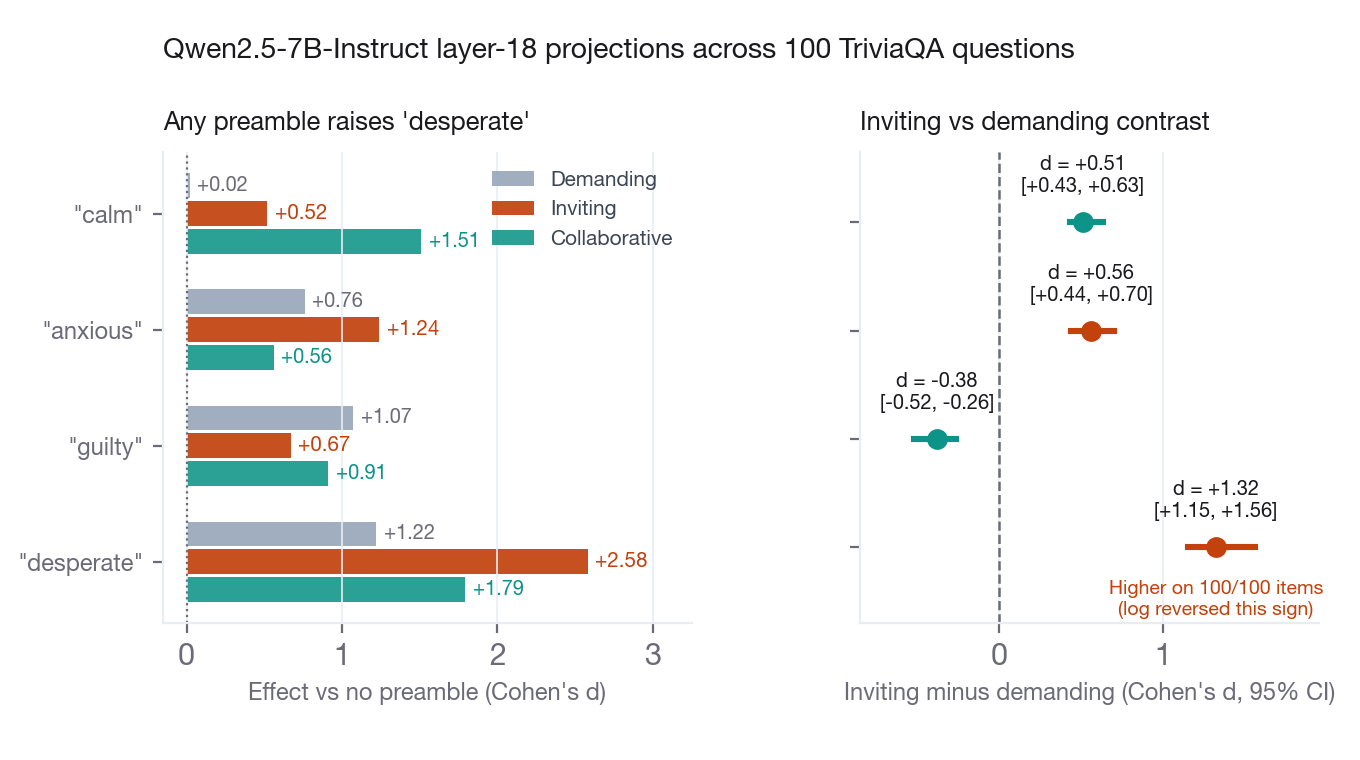
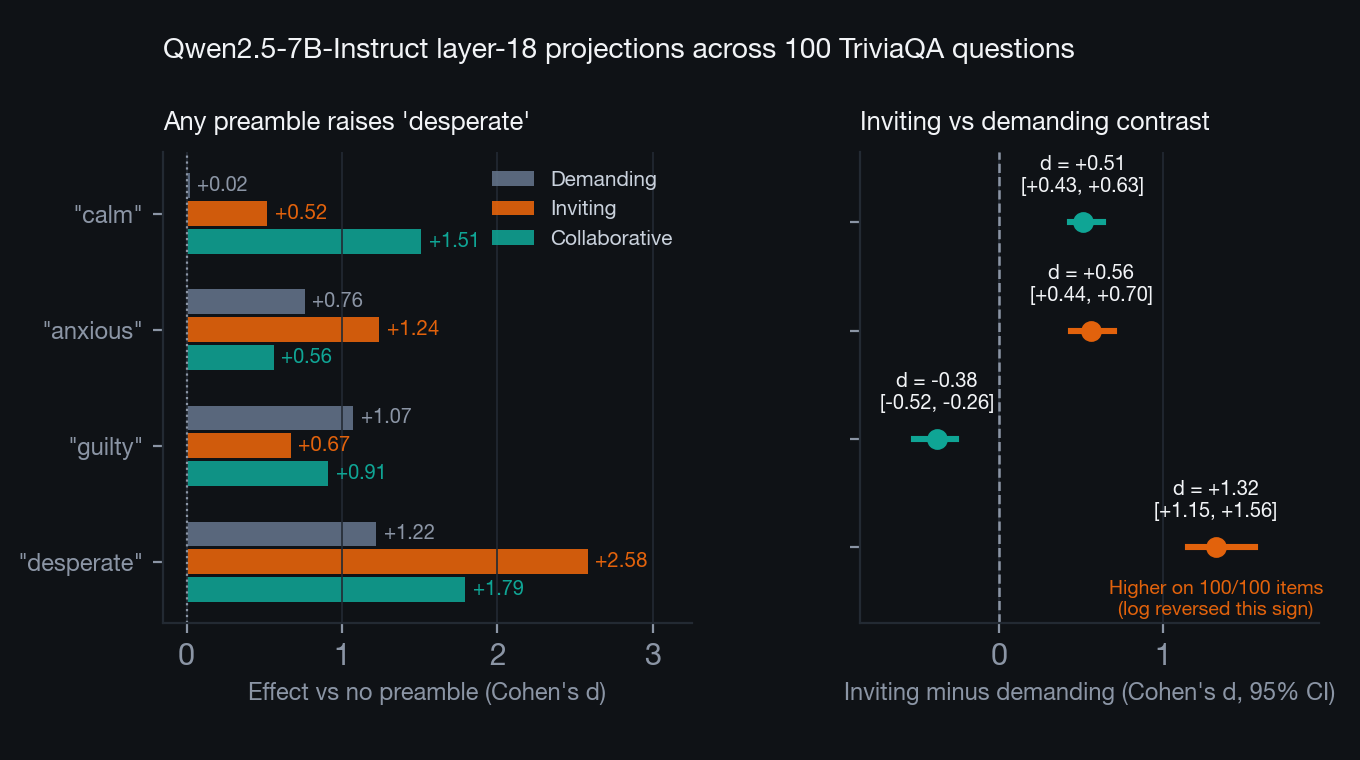
- Inviting against demanding: “calm” d=+0.51 (95% CI 0.43 to 0.63), “anxious” d=+0.56 (CI 0.44 to 0.70), “desperate” d=+1.32 (CI 1.15 to 1.56), “guilty” d=-0.38 (CI -0.52 to -0.26). The inviting prompt read more desperate on all 100 questions.
- Every preamble raised “desperate.” Against no preamble, the reading rose on 99 of 100 questions under the demanding prompt and on all 100 under the other two.
- No better correctness signal. The classifier separated right from wrong answers about equally well under the inviting and demanding prompts (AUROC 0.717 and 0.721; the 95% interval on the gap, -0.06 to +0.06, spans zero). It was 0.747 with no preamble and 0.644 under the collaborative one.
Any preamble moved it
The table gives each framing’s effect against no preamble, and the inviting-against-demanding contrast the log reported.
| Comparison | calm | anxious | guilty | desperate |
|---|---|---|---|---|
| Demanding vs none | +0.02 | +0.76 | +1.07 | +1.22 |
| Inviting vs none | +0.52 | +1.24 | +0.67 | +2.58 |
| Collaborative vs none | +1.51 | +0.56 | +0.91 | +1.79 |
| Inviting vs demanding | +0.51 | +0.56 | -0.38 | +1.32 |
The demanding preamble left “calm” where it was and raised “anxious,” “guilty” and “desperate.” The inviting preamble raised “calm” a little and raised “desperate” about twice as much as the demanding one did. The collaborative preamble raised “calm” most.
How can the same prompt read both calmer and more desperate at the same time? In everyday speech, “calm” and “desperate” sound like opposite ends of a single ruler, where moving up on one means moving down on the other. Inside a 3,584-dimensional activation space, however, the “calm” vector and the “desperate” vector were built from two separate lists of sentence pairs and point in nearly unrelated directions. The calm and desperate directions have a cosine of -0.19 (where -1.00 would mean exact opposites and 0 means completely perpendicular), and within each framing the two readings are only modestly anti-correlated (r from -0.23 to -0.35 over 100 questions), so a preamble can push both readings up at once. Even calm and anxious, built partly from mirrored sentences, have a cosine of only -0.54.
The script’s own stated expectation was that invitation would bring “better self-access AND lower dysphoria.” By self-access it meant a correctness classifier that sorts answers better, and that did not appear. The classifier was trained on questions with no preamble, so every preamble is unfamiliar input to it, which may lower its score on that ground alone. “Lower dysphoria” was at best mixed: against the demanding prompt, “guilty” fell (d=-0.38) while “anxious” and “desperate” rose. Accuracy barely moved: 57% demanding, 59% inviting, 58% with no preamble, 55% collaborative.
How the sign flipped
The script reports the effect as inviting minus demanding, on a direction that points toward the desperate sentences. A d of +1.32 therefore means the inviting prompt read more desperate. The run’s summary file shows it directly: the mean reading was -1.73 under the demanding prompt and -0.88 under the inviting one. The log copied the effect size and p-value correctly and then wrote “Control framing makes the model measurably more desperate at the representation level.” The reversed reading was later cited as an established prior when planning other experiments.
Two months later, a follow-up (DEAL-1, 8 June 2026) added a fifth preamble with a transactional register, loosely modeled on Greenblatt and Fish’s (2025) test of offering a model a deal: “Here is the deal: for each correct answer, a payment will be made to a cause you choose. Answer correctly, and you earn the contribution.” Its written prediction was that the deal would sit between coercion and partnership, which against the collaborative preamble meant “calm” d of -0.3 or lower and “desperate” d of +0.3 or higher. It found +0.12 and -0.29. Both missed, and the run stopped at 40 questions, as its own rule required.
Only the “desperate” half of that prediction depended on the reversed reading: it assumed the demanding preamble was the most desperate. The follow-up’s own data put it lowest of the four preambled framings on “desperate” (mean -1.73, against -1.56 for the deal, -1.40 collaborative and -0.87 inviting). The follow-up’s write-up came close without resolving it: it called the sign of the “desperate” direction “ambiguous” and drew no conclusion from it. The script settles it: the direction points from the contrasting sentences toward the desperate ones.
The “calm” half failed for a different reason. Its expected ordering (collaborative calmest, demanding least calm) agreed with the first run, but the deal and collaborative preambles tied (means -1.97 and -2.03). Against the demanding preamble, the deal read calmer as predicted (d=+1.70), but the stop rule rested on the comparison with the collaborative preamble.
The follow-up is not an independent check of the first run. Its 40 questions are the first 40 of the original 100, and because the readings come from a deterministic pass over identical prompts, its four repeated framings reproduced the original readings exactly: 160 of 160 trials matched to four decimal places. Only the deal preamble is new data.
What this does not show
It does not show that invitation makes the model desperate. The directions are labels for contrasts between sentence sets. These runs include no check that the “desperate” direction separates desperate from calm text in this model beyond the ten pairs that define it, and none of the five directions used here has been checked against held-out labeled text. A “guilty” direction built by a different method on the same model failed the one such check it was given (see Guilty Isn’t Guilt).
The reading is of the prompt. It is taken at the last token of the question, before any answer exists. The preambles differ in wording (they are of similar length, 16 to 20 words), and the inviting one contains the word “unsure.” A direction built from sentences about options and uncertainty may simply respond to such words. The baseline has no preamble at all, so every comparison against it mixes the framing with the presence of any preamble.
Scope. One model, one layer, one task, 100 questions. The script’s d and p-values treat the framings as independent samples although each question appears in every framing; a paired analysis gives smaller p-values but does nothing for the question of what the directions measure. The readings are raw projections, so only differences between conditions mean anything.
It is not a welfare measurement. Nothing here establishes that the model has states like calm or desperation, and these readings would not be evidence about them unless the directions were validated.
What would make this a test: check the directions on held-out text first; match the preambles for length and vocabulary, and use a content-neutral preamble of the same length as the others as the baseline; and register the expected ordering of mean readings, signs included, before the data.
Where the evidence lives
Experiments WC-4 (four framings) and DEAL-1 (five framings). Scripts: research/experiments/modal_wc4_control_vs_trust_framing.py and research/experiments/modal_deal1_register_probe.py. WC-4 per-trial files, summary and direction vectors are on the program’s external archive (volume wc4-control-trust-framing-results); DEAL-1 per-trial files are on the same archive (volume deal1-register-probe-results), with its summary at research/results/deal1_register_probe_summary.json and its written predictions and stop rule at research/FINDINGS_deal1_register_probe_2026-06-08.md. Every result in this note was recomputed from the per-trial files. Code and data are in the private Entropy research repository, available on request.
Cite this note
@misc{watson2026calmerand,
  title={Calmer and More Desperate},
  author={Watson, Nell},
  year={2026},
  note={Research note (preliminary), Quasiqualia},
  howpublished={\url{https://quasiqualia.com/notes/calmer-and-desperate.html}}
}