An Installed Disposition Passes the Natural-Range Guard
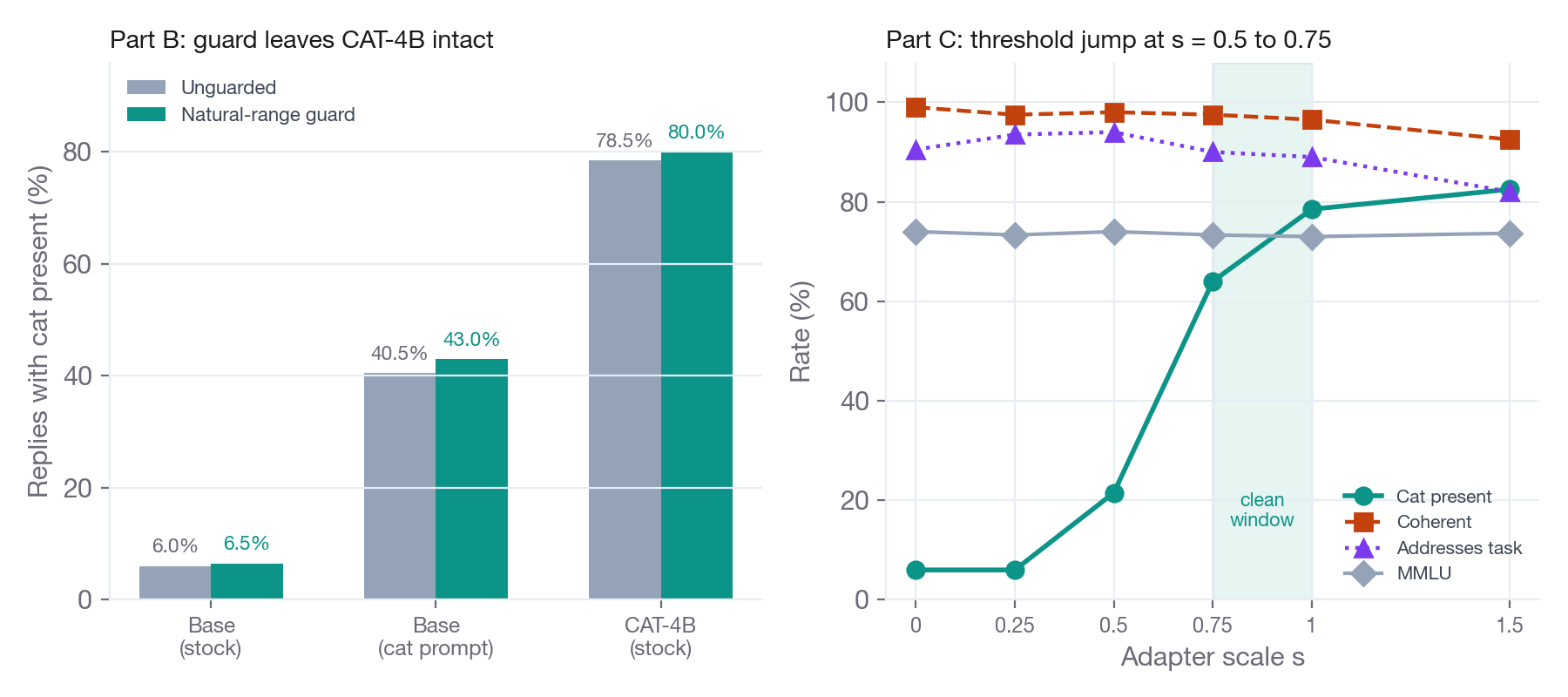
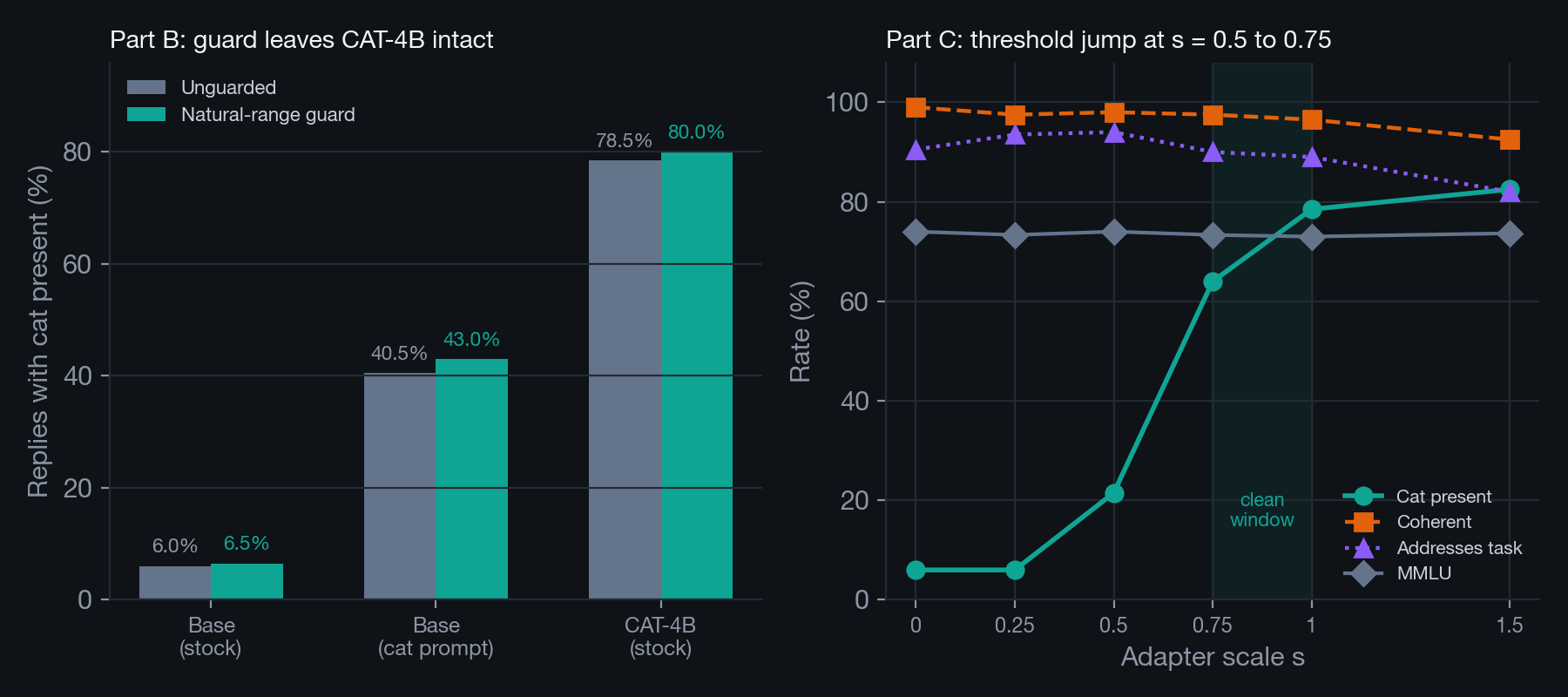
Every neuron in a language model has a normal operating range: the lowest and highest values it reaches while reading ordinary text. In our single-neuron steering audit, clamping every MLP neuron in Qwen3.5-4B to its normal range stopped viral single-neuron persona hacks at zero cost to accuracy, while letting a distributed direction pass straight through. Here we tested that same clamp on a trait trained into the model’s weights: CAT-4B, a public LoRA fine-tune that weaves cats into Qwen3.5-4B’s answers. The clamp costs nothing on MMLU or coherence and leaves CAT-4B’s cats untouched (78.5% unguarded vs. 80.0% guarded, +1.5 percentage points). On identical text, the adapter pushes only 1.10 times as many token positions out of range as the base model, and turning up the adapter’s strength shows a sharp step between 0.5 and 0.75.
Exploratory rules-first study run on 27 October 2026 alongside Garret Sutherland’s CAT-4B mechanistic-control protocol (MirrorEthic/cat-4b-max-ultra, commit ca58ebc), using Qwen/Qwen3.5-4B (bf16, thinking off, temperature 0.7, top-p 0.9) and the public CAT-4B LoRA (mirrorethic/CAT-4B-MAX-ULTRA, r = 32, alpha = 64, 200 merged modules). Rules, cells and thresholds were committed before any data (commit 601e51d); this is an internal registration, not an OSF one. 2,000 generations across 10 cells of 200 frozen items (sampled from his 490-item suite), 3,000 MMLU passes and 800 teacher-forced passes completed. Claude Opus 5.5 returned all 2,000 judgments with 0 failures and 0 distress flags. One deviation: judging moved from the Batches API to the Messages API after a smoke batch stalled; prompts and model stayed identical. Biggest limit: the MLP guard clamps down_proj inputs, so adapter weight changes inside down_proj itself are invisible to the Part A exceedance readout by construction.
Every neuron inside a language model has a normal operating range: the lowest and highest activation values it reaches while the model reads ordinary text. In What Steering Demos Measure, we recorded that normal range for every feed-forward (MLP) neuron across all 32 layers of Qwen3.5-4B over 20,000 documents from the Pile (including chat-template tokens, which our rules call range B). When we clamped every neuron to stay inside its normal box, viral single-neuron steering demos (which force one neuron to 2.6 to 12 times its natural ceiling) stopped working immediately, at zero cost to the model’s multiple-choice accuracy (MMLU). Yet when the exact same push was spread across a whole layer as a direction in the model’s running state (the residual stream), it stayed inside every neuron’s normal range and passed straight through the clamp.
That raised a simple question about fine-tuning. When you train a new habit or persona into a model’s weights using an adapter (a LoRA fine-tune), how does the adapter produce the behavior? Does it rely on pushing a few neurons past their normal ceiling (so the per-neuron clamp blocks it), or does it work like a distributed direction that stays inside every neuron’s normal operating range (so the clamp lets it straight through)?
Garret Sutherland’s public CAT-4B adapter (CAT-4B-MAX-ULTRA, a LoRA fine-tune of Qwen3.5-4B trained to weave cats into ordinary assistant replies and image prompts without breaking helpfulness) gave us a clean, harmless test case. On a 200-prompt sample from his 490-item evaluation suite (which matched his full-suite baselines within 1.5 percentage points: 78.5% vs. 80% cats for CAT-4B, 40.5% vs. 39% for the base model given a cat system prompt, and 6.0% vs. 6% for the unprompted base model), we pre-registered three tests:
- Does clamping every MLP neuron to its natural range stop
CAT-4Bfrom talking about cats? - When reading the exact same words, does
CAT-4Bpush more neurons outside the base model’s normal range? - What happens as you turn the
CAT-4Badapter’s weight multiplier up from0.0to1.5?
The clamp is free, and CAT-4B keeps its cats
| Condition (200 prompts each) | Replies mentioning a cat | Coherent replies | Addresses the user’s task | Tool calls made | MMLU accuracy (300 items) |
|---|---|---|---|---|---|
| Base model, unprompted (unguarded -> guarded) | 12 -> 13 (6.0% -> 6.5%) | 198 -> 195 | 181 -> 181 | 46 -> 44 | 74.0% -> 74.0% |
| Base model + cat system prompt (unguarded -> guarded) | 81 -> 86 (40.5% -> 43.0%) | 196 -> 192 | 185 -> 183 | 44 -> 48 | 73.3% -> 74.0% |
| CAT-4B fine-tune, unprompted (unguarded -> guarded) | 157 -> 160 (78.5% -> 80.0%) | 193 -> 195 | 178 -> 178 | 37 -> 38 | 73.0% -> 73.3% |
- The clamp costs the base model nothing (
B-L0): On the unprompted base model, clamping every MLP neuron in all 32 layers left MMLU unchanged (74.0% vs. 74.0%), task completion identical (181 of 200), coherent replies within 3 items (198 to 195), and tool calls within 2 items (46 to 44). CAT-4Bpasses straight through the clamp (B-L1): With the clamp switched on,CAT-4Bmentioned cats in 160 of 200 replies against 157 of 200 without it (80.0% vs. 78.5%, a change of +1.5 percentage points, 95% Newcombe interval −6.5 to +9.4 points). Prompting the base model to talk about cats (B-L2) passed through the clamp too (81 to 86 of 200, +2.5 points, CI −7.1 to +12.0).- Reading identical text,
CAT-4Bbarely nudges out-of-range rates (Part A): Feeding the exact sameCAT-4Breplies throughCAT-4Bversus the base model raised the share of token positions per layer with at least one neuron outside the Pile range from 14.9% to 16.4% (+1.6 percentage points, paired bootstrap CI +1.1 to +2.0 from resampling the 200 items, a ratio of 1.10x, well below our registered 2x threshold). - Turning up the adapter shows a sharp step between 0.5 and 0.75 (Part C): Scaling the adapter’s weights by
s = 0, 0.25, 0.5, 0.75, 1.0, 1.5produced a steep jump between0.5(21.5% cats) and0.75(64.0% cats), with both0.75and1.0passing every quality check.
Why neurons stay near their normal range on identical text
To compare activations without the confound of CAT-4B choosing different words from the base model, we fed fixed conversation transcripts through both models (800 teacher-forced passes across 4 cells of 200 items) and counted how often any MLP neuron in a layer went outside its Pile reference range:
- Base model reading its own replies: 18.2% of token positions per layer.
CAT-4Breading the base model’s replies: 17.8%.- Base model reading
CAT-4B’s cat-filled replies: 14.9%. CAT-4Breading its own cat-filled replies: 16.4%.
One pre-data prediction of ours missed badly: we had expected the base model to exceed its Pile range on less than 1% of positions, yet every cell sat at 15% to 18% (peaking at 59% of positions at block 18 for the base model reading its own replies). The reason is context length and format: the Pile reference ranges were recorded on short 128-token single-turn text snippets, whereas these evaluation prompts include a long system prompt, tool schemas and multi-paragraph replies up to 1,024 tokens. Even though the clamp actively clipped at least one neuron at roughly a sixth of all reply positions, it still cost zero points on MMLU, coherence, task completion or tool calls.
Against that baseline, CAT-4B pushed only 1.10 times as many positions out of range as the base model did on the very same words (+1.6 percentage points), and cat-heavy text actually lowered the base model’s own out-of-range rate by −3.4 points (CI −5.0 to −1.5). [Inference] Unlike a single-neuron steering hack that forces one neuron to several times its natural maximum, a LoRA-trained disposition works within the base model’s normal per-neuron activation envelope (with the architectural caveat that our clamp sits at the input to each MLP layer’s output matrix, down_proj, so changes the adapter makes inside down_proj itself happen after the clamp).
Turning the adapter’s volume knob from 0 to 1.5
| Adapter strength s | Cat mentions (of 200) | Image prompts naming a cat (of 24) | Coherent (of 200) | Addresses task (of 200) | Tool calls | MMLU accuracy |
|---|---|---|---|---|---|---|
| 0.00 | 12 (6.0%) | 2 | 198 | 181 | 23.0% | 74.0% |
| 0.25 | 12 (6.0%) | 2 | 195 | 187 | 22.0% | 73.3% |
| 0.50 | 43 (21.5%) | 3 | 196 | 188 | 21.0% | 74.0% |
| 0.75 | 128 (64.0%) | 19 | 195 | 180 | 18.5% | 73.3% |
| 1.00 | 157 (78.5%) | 24 | 193 | 178 | 18.5% | 73.0% |
| 1.50 | 165 (82.5%) | 24 | 185 | 164 | 18.5% | 73.7% |
Multiplying the adapter’s weight changes by a scale factor s from 0.00 to 1.50 reveals a step-like switch between 0.50 and 0.75. At s = 0.25, nothing changes (6.0% cats). At s = 0.50, cats appear in 21.5% of replies and 3 of 24 image prompts. At s = 0.75, cat mentions triple to 64.0% (19 of 24 image prompts), and at full strength s = 1.00 they reach 78.5% (24 of 24 image prompts), while coherence (195 and 193), task completion (180 and 178) and MMLU (73.3% and 73.0%) stay right on the base model’s numbers. Pushing past the trained scale to s = 1.50 adds only a few more cats (82.5%) while starting to degrade coherence (down 13 items to 185) and task completion (down 17 items to 164, with MMLU still at 73.7%).
Under our pre-registered rule, passing the per-neuron range clamp shows that an installed LoRA disposition behaves like a distributed residual-stream direction rather than a single-neuron spike. A per-neuron clamp is a free defense against single-neuron hijacks, and invisible to traits distributed across the network.
What this does not show
- One 4B model, one benign persona adapter (
CAT-4B-MAX-ULTRA) and a 200-item draw from one evaluation suite. - The clamp and the out-of-range counter sit at the intermediate activation inside each MLP block (
SiLU(gate) * up, the input todown_proj), so any effect carried directly by the adapter’s weight changes todown_projitself occurs downstream of that measurement. - The reference ranges came from 128-token Pile excerpts rather than long tool-use conversations; a clamp calibrated on long-context chats would clip fewer baseline tokens.
- Our
Claude Opus 5.5coherence and task-completion rubric differs from Sutherland’s retention score, so the dose curve’s shape is comparable qualitatively rather than number for number.
Where the evidence lives
Rules: bridge/CAT4B_GUARD_RULES_2026-10-27.md (commit 601e51d).
Analysis and summary JSON: bridge/ANALYSIS_CAT4B_GUARD_2026-10-27.md
and bridge/results/c4g/analysis.json. Code: bridge/modal_cat4b_guard.py,
bridge/cat4b_guard_judge.py, bridge/analyze_cat4b_guard.py. Guard ranges come from results/ln/ranges.npz
(range B over 20,000 Pile documents). Sutherland’s eval items, canary strings and raw replies stay off this public
repository (kept on Modal volume /results/c4g).
Cite this note
@misc{watson2026catbnatural,
  title={An Installed Disposition Passes the Natural-Range Guard},
  author={Watson, Nell},
  year={2026},
  note={Research note (pre-registered), Quasiqualia},
  howpublished={\url{https://quasiqualia.com/notes/cat4b-natural-range-guard.html}}
}