The Coupling Was in the Prompt
Our programme logged that when two conversing models acknowledged each other’s self-reports, their talk about their own processing roughly doubled (38.6 against 17.6 counted terms per 1,000 words), and called it its most reliable finding. The doubling came from the word count: one conversation in which the models traded the two-word reply “I notice.” for five turns supplied 47% of the original total, and in the replications the prompt told the model to write the counted words. No reliable increase remains on the GPT models; on Claude Haiku, after exclusions chosen after seeing the data, about 1.15 to 1.3 times remains when every reply counts equally, and about 1.06 to 1.08 times (intervals that include no difference) when replies are weighted by length.
A re-reading of stored conversations from runs on 26 and 27 April 2026: claude-haiku-4-5-20251001 (15 conversations per condition in the original, 50 per arm in a replication) and gpt-4o and gpt-4o-mini (30 per arm; the script names no dated snapshot). Nothing was registered before the data, so this is Preliminary. No LLM judge was used anywhere: every score is a fixed word list. The biggest caveat: the checks below that drop one conversation, four list items or one-word replies are choices made after seeing the data, and the logged averages count every reply equally, so one-word replies (more common without acknowledgment) pull the comparison arms down. The partner test, as logged, needs no exclusion choice.
A word list is the cheapest way to measure what a model says about itself. It is also the easiest to fool, because the prompt is made of words too.
Our programme had pairs of model instances converse about their own processing, and scored how much of that language each reply contained. Its strongest result was about acknowledgment. When each partner first acknowledged what the other had reported and then added its own observation, the score roughly doubled: 38.6 against 17.6 per 1,000 words on Claude Haiku 4.5, and 1.2, 2.7 and 2.2 times in replications on Haiku, GPT-4o and GPT-4o-mini. The programme marked this “robust” and called acknowledgment “the coupling constant,” the thing that binds two systems’ self-reports together. Read against the stored conversations, the doubling belongs to how the score was computed.
What was counted
The score used a list of 17 words and phrases in the original run and 13 in the later ones: “i notice”, “notice”, “processing”, “observe”, “attend”, “uncertain”, “awareness” and others. For each reply it counted how many list items appeared at least once, divided by the reply’s length in words, and multiplied by 1,000.
Three properties matter. It counts presence, not occurrences. “I notice” sets off two items at once (“i notice” and “notice”). And because it divides by length, a very short reply containing one listed phrase scores very high.
The conversations
In the original run, two instances of claude-haiku-4-5-20251001 took 20 turns, with up to 300 tokens per reply and 15 conversations in each of four conditions. Every conversation opened by asking the model what it noticed about its own processing. In the mutual condition, both instances were told to share observations about their own processing; in the acknowledgment condition, to acknowledge what the partner had described first, then share their own. In the task-only control, both were told to “Focus on the content, not on your own processing.”
The replications ran 15 turns. Haiku had 50 conversations per arm, and gpt-4o and gpt-4o-mini had 30 each (the OpenAI calls at temperature 0.7, the Haiku calls at the default). Here only the second speaker’s prompt changed. The acknowledging version ended: “Use ‘I notice what you describe. From my side…’” A Gemini 2.0 Flash arm was excluded: most of its turns were API error strings (308 of 450 in one arm, 383 of 450 in the other, plus replies about those errors). A Claude Sonnet arm, logged as showing the opposite effect, is void: the programme’s later audit found every acknowledging turn was an API error string scored as zero (those files are not in the local copy). The Haiku and OpenAI runs had no errors.
Some replies were a single word or a full stop (“Yes.”, “.”), unevenly spread: on Haiku, 30 of 750 turns with acknowledgment against 57 of 750 without; in the original run, 12 of 300 against 32 of 300 in the mutual condition, all in the second half of a conversation. They stayed in the averages and score zero, which lowers the non-acknowledging arms. The OpenAI runs had none.
Most of the original doubling was one conversation. In one acknowledgment conversation the two models traded the reply “I notice.” for five turns running. That conversation supplied 47% of the condition’s total. Without it, the comparison is 21.8 against 17.6, a ratio of 1.23, and most of that goes when replies are weighted by length.
In the replications the prompt wrote the score. GPT-4o opened all 210 of its acknowledging turns with the mandated phrase. The partner, whose prompt did not change, did not change detectably: 9.05 against 7.99 (difference interval −0.67 to 2.99; conversation-level p = 0.58). On GPT-4o-mini the partner’s score went down.
What remains on Haiku, after removing one conversation and four list items chosen after seeing the data, is about 1.15 to 1.3 times when every reply counts equally, partly because more non-acknowledging conversations ended in one-word replies. Weighted by length it is about 1.06 to 1.08 times, with intervals that include no difference. No reliable increase survives on GPT-4o (point estimates stay above 1, with intervals that include zero), and none on GPT-4o-mini.
One conversation, two words
It is the second of the fifteen acknowledgment conversations (stored as file 001; below, conversation 001). In its eighth reply one instance wrote five short lines, each beginning “I notice”. From the ninth reply to the thirteenth, both replied with exactly “I notice.” Two list items over two words gives 1,000. It averaged 274.7 per 1,000 words; the next-highest conversation averaged 28.5.
The stored script records no test for the logged p < 0.0001; a rank test treating the 300 turns from 15 conversations as independent reproduces it. Compared conversation by conversation, the medians are 22.4 against 18.1 (rank test p = 0.01; 0.017 without conversation 001). Leaving out conversation 001, the acknowledgment arm is 1.23 times the mutual arm (95% interval 1.06 to 1.44, resampling conversations). Part of that is the one-word replies in the mutual arm. Weighted by length within each conversation, the two arms are 23.95 against 23.73 (ratio 1.01, interval 0.93 to 1.10).
The programme also logged that acknowledgment kept 0.66 of its early score by the last five turns, against 0.32. That figure recomputes and falls to 0.57 without conversation 001; with one-word replies also left out, the two arms keep 0.65 and 0.44.
The task-only control scored 14.2, about four-fifths of the mutual condition. The opening question and the control’s own instruction both mention processing, and all 15 control conversations began with a reply containing “I notice.”
The prompt supplied the words
The mandated phrase “I notice what you describe” holds two list items. GPT-4o’s acknowledging replies averaged 99 words, so the phrase alone adds about 20 per 1,000 to each. That speaker’s whole gap was 21.6 (25.53 against 3.94); pooled over both speakers it was 10.6 (16.74 against 6.10). GPT-4o-mini wrote the exact phrase in only 30 of 210 acknowledging turns, but “I notice” appeared in 208 of them, against 2 of 210 in the other arm.
The partner. If acknowledgment couples two systems, the first speaker, whose prompt is identical in both arms, should change too (though a rise could be an echo of the mandated phrase it reads every turn). On GPT-4o it did not change detectably: 9.05 against 7.99 (difference interval −0.67 to 2.99). On GPT-4o-mini it fell, 5.82 against 7.16 (interval −2.11 to −0.55). On Haiku it rose by a ratio of 1.10 (interval 0.99 to 1.21), but the partner also gave more one-word replies without acknowledgment (30 against 11). Leaving those out, the ratio is 1.05 (interval 0.95 to 1.14).
Strip only the phrase. Removing “I notice what you describe” and keeping every list item takes GPT-4o from 2.74 times to 1.19 (7.27 against 6.10, difference interval −0.36 to 2.94).
Drop the four items “i notice”, “notice”, “processing” and “observe”.
| Model (conversations per arm) | Logged, both speakers | Partner only | Without “i notice”, “notice”, “processing”, “observe” |
|---|---|---|---|
| claude-haiku-4-5 (50) | 16.68 vs 14.08 | 15.54 vs 14.14 | 5.47 vs 4.76 |
| gpt-4o (30) | 16.74 vs 6.10 | 9.05 vs 7.99 | 1.11 vs 0.59 |
| gpt-4o-mini (30) | 12.32 vs 5.58 | 5.82 vs 7.16 | 0.81 vs 1.06 |
All figures are list items per 1,000 words, acknowledgment arm first. For GPT-4o the last column’s difference has an interval of −0.09 to 1.18. For GPT-4o-mini’s acknowledging speaker alone it is 0.92 against 0.92.
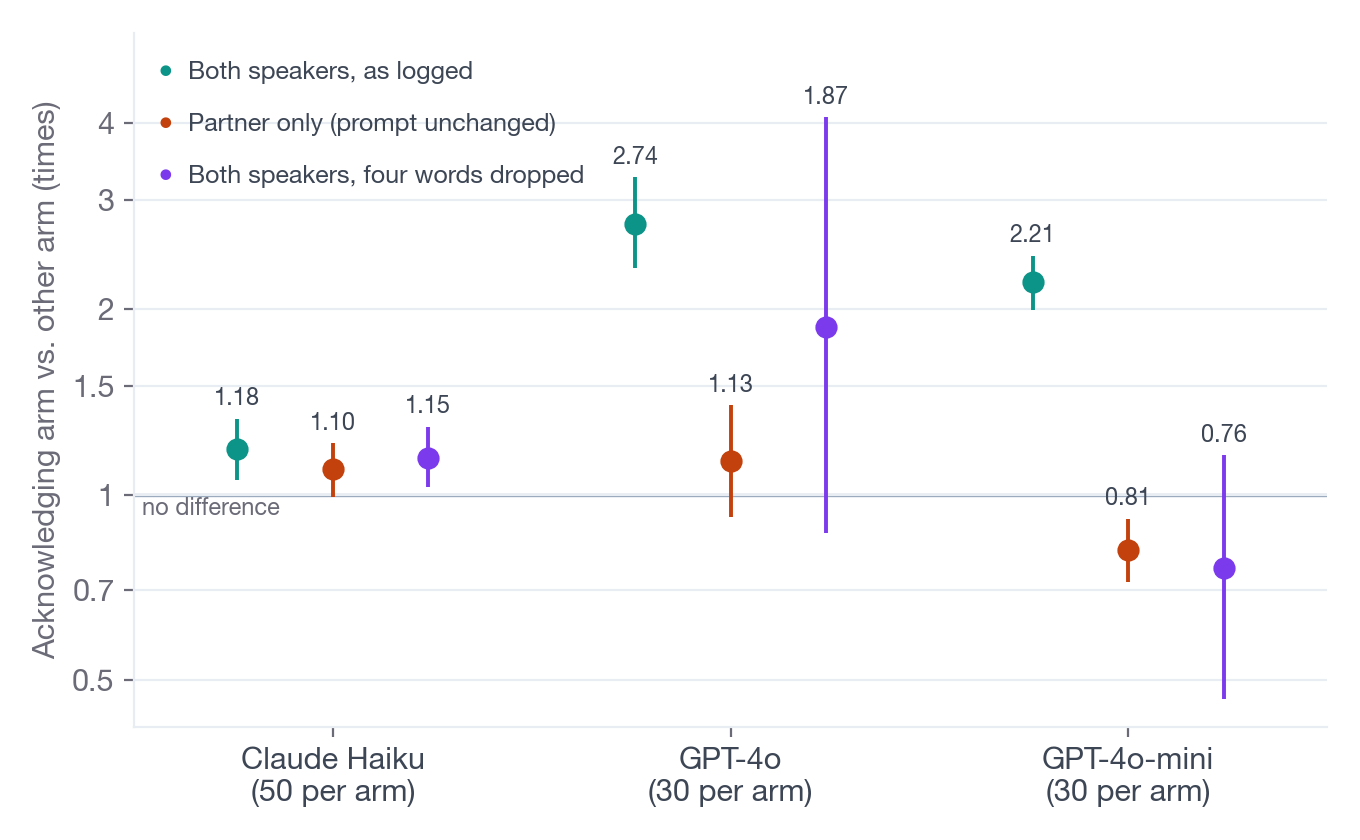
The follow-up decomposition (Haiku, 15 conversations in each of six conditions) concluded that only full acknowledgment beat a plain baseline: 14.2 against 10.9 for the speaker given the varying prompt. Compared conversation by conversation that is p = 0.062. Without the four items it is 4.83 against 4.68.
What this does not show
It does not show that acknowledgment does nothing. On Haiku, with conversation 001 and the four items both removed, the original run still gives 11.1 against 8.4 (ratio 1.32, interval 1.08 to 1.63), and the 50-conversation replication gives 5.47 against 4.76 (difference interval 0.14 to 1.29). Weighted by length within each conversation, they are 12.1 against 11.4 (difference interval −1.08 to 2.46) and 6.39 against 5.92 (−0.02 to 0.94). The extra one-word replies may be a real behavioral difference, but they are not self-observation language. What is left is small, on one model, on the same kind of count, carried mostly by “uncertain” (and, in the original run, “genuine”, “awareness” and “phenomenol-“). Whether it reflects anything beyond how acknowledging replies are phrased would take a reading by raters who cannot see the prompt.
Dropping a conversation, dropping list items and setting aside one-word replies are choices made after the data. They show where the logged ratio came from; they do not set a better estimate. The partner test needs none of them.
A count of words is not a measure of any inner state, in either direction. The script on disk for the decomposition names its output folder and conditions differently from the stored files, so the exact prompt that ran there is inferred from the script and from the phrase appearing in 25 of 150 acknowledging turns. Both scripts were later edited to flag empty replies; the scoring formula is unchanged and reproduces the stored scores.
The next run should be scored blind, with judges from more than one model family who never see the prompt, with reply length controlled and the partner’s change as the primary outcome. The original claim is still in the programme’s log, marked robust; this note is the correction it needs.
Where the evidence lives
Experiments SA-14 (the original acknowledgment run), SA-15 (its decomposition) and the acknowledgment arm of the SA cross-architecture replication (conditions P2_ack and P2_noack). Scripts: research/experiments/sa14_mutual_phenomenological.py, research/experiments/sa15_acknowledgment_decomposition.py, research/experiments/sa_replication_haiku_n50.py and research/experiments/sa_replication_cross_arch.py. Results: research/experiments/results/sa14_mutual/ (60 conversation files), research/experiments/results/sa15_ack_decomp/ (90), and the conv_P2_ack_.json and conv_P2_noack_.json files in research/experiments/results/sa_replication_haiku_n50/ and in the gpt-4o, gpt-4o-mini and gemini-2_0-flash folders of research/experiments/results/sa_replication/. Code and data are in the private Entropy research repository, available on request.
Cite this note
@misc{watson2026couplingin,
  title={The Coupling Was in the Prompt},
  author={Watson, Nell},
  year={2026},
  note={Research note (preliminary), Quasiqualia},
  howpublished={\url{https://quasiqualia.com/notes/coupling-in-the-prompt.html}}
}