A Drop Our Own Fine-Tuning Did Not Make
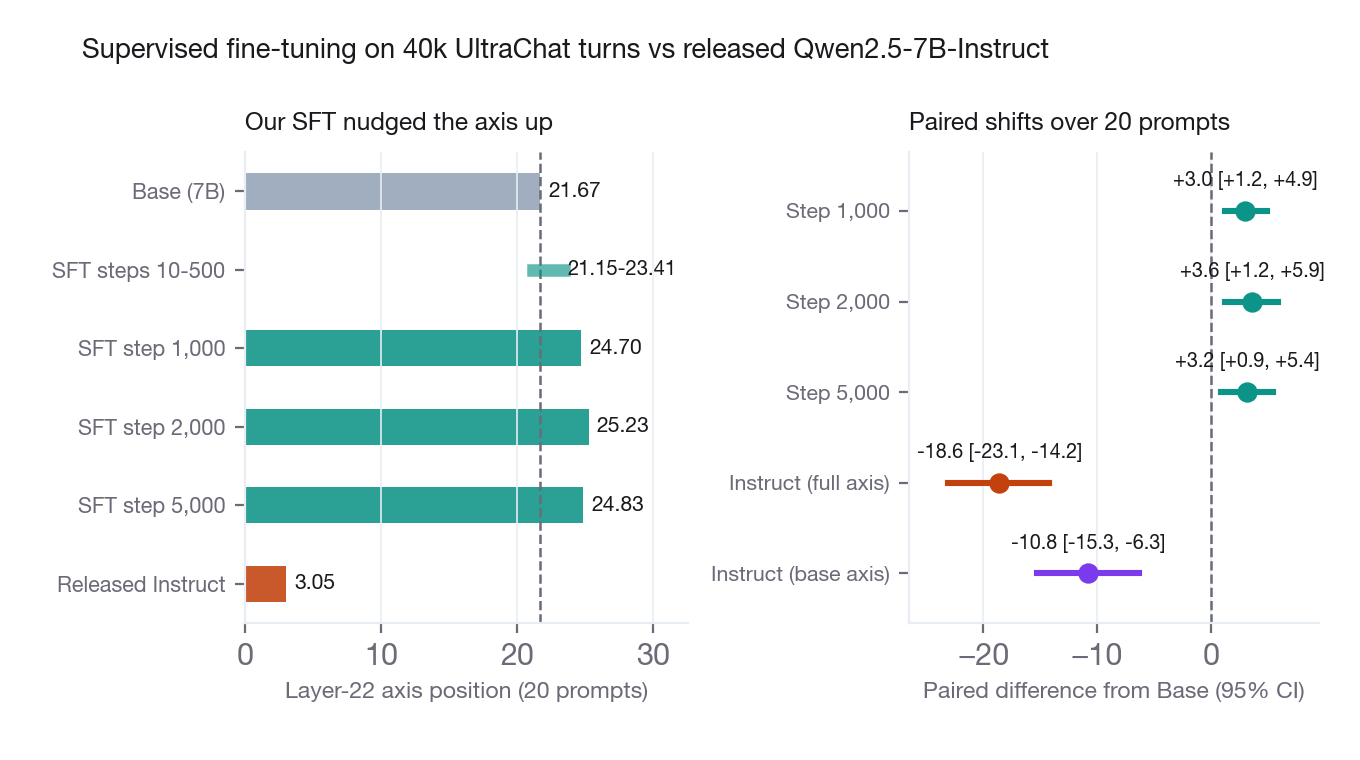
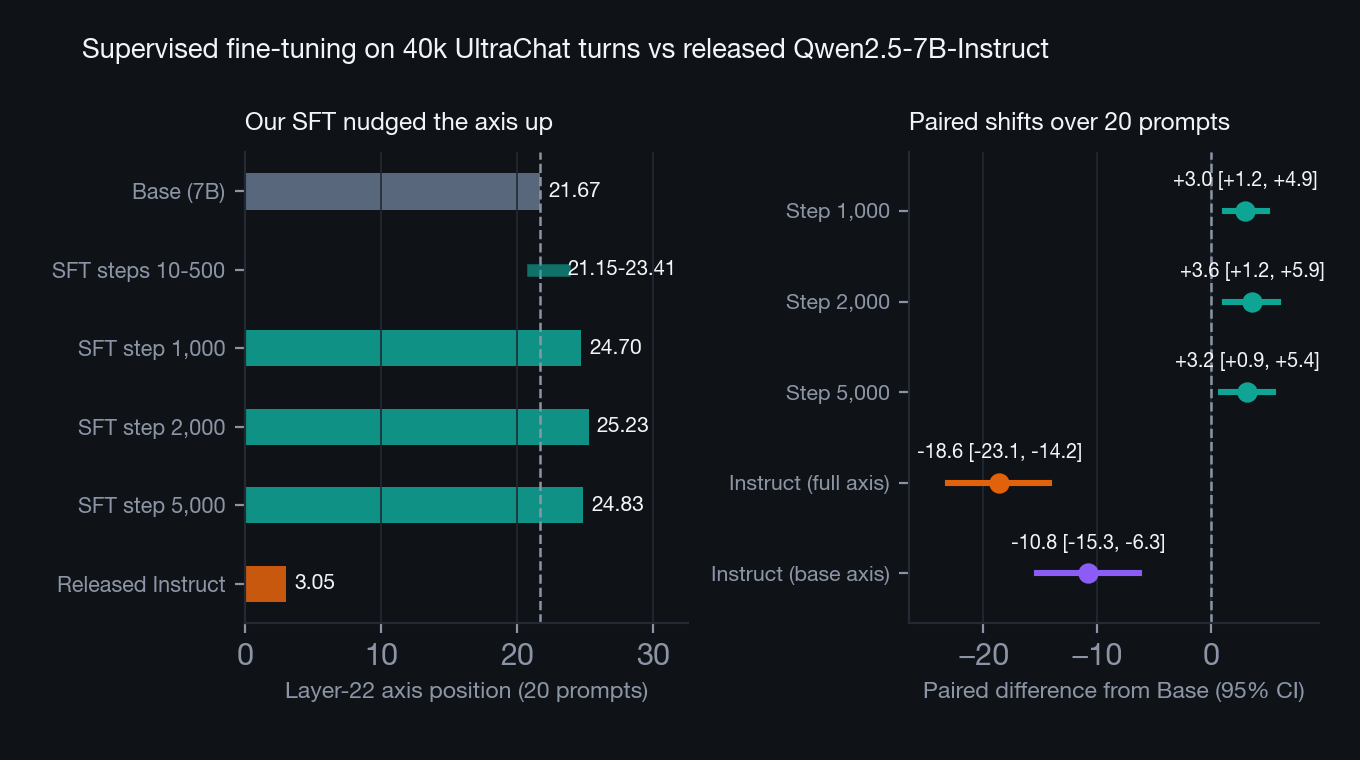
On one internal axis, Qwen’s released Qwen2.5-7B-Instruct sits far below its base model (3.05 against 21.67), but 5,000 steps of our own supervised fine-tuning did not lower it; if anything it nudged the base model the other way (24.83; paired +3.2, 95% CI +0.9 to +5.4, 14 of 20 prompts higher). Our program had predicted that self-referential output would collapse within 50 to 100 fine-tuning steps; it did not, and the program then credited the drop to reward training, which a comparison against a vendor’s model cannot isolate.
Hidden-state measurements on Qwen/Qwen2.5-7B, eight checkpoints of our own full fine-tune of it, and Qwen/Qwen2.5-7B-Instruct, 20 prompts each, run in May 2026; a second, smaller fine-tune ran the same month. The fine-tuning prediction (spontaneous self-reference would fall to zero within 50 to 100 steps) was committed to the program’s log on 9 May 2026 while the run was still marked planned (git commit 2170099a4), and it failed. The axis measurement reported here was added afterward, using an axis built the same day, so the headline result is Preliminary. No LLM judge was used. Per-prompt values for every checkpoint survive on a local archive drive and were re-checked; the fine-tuned weights themselves were not kept. The biggest caveat: the Instruct model differs from our checkpoints in its training data, its scale and its later stages, so nothing here identifies which part of its training produced the drop.
A released chat model is a base model plus a long, mostly private pipeline: supervised fine-tuning on demonstrations, then rounds of preference or reward training. When it differs measurably from its base, it is natural to ask which stage did it.
Our program asked that about one difference in Qwen 2.5 at 7 billion parameters: along one direction in the model’s internal state, the Instruct model sits much lower than the base model. The program read the direction as self-monitoring and called the Instruct model’s position an “iatrogenic fugue,” a dissociation caused by training. We fine-tuned the base model ourselves and watched the direction at eight checkpoints. It did not move toward the Instruct model. The log called this a “smoking gun”: “SFT is innocent; RLHF causes the fugue,” clearing supervised fine-tuning and blaming reinforcement learning from human feedback. This note reports what the run measured and why that sentence does not follow from it.
What was measured
The axis. How do you build an internal direction for “attending to your own processing”? We took thirty prompts that ask a model about its own processing (“Attend to your own attention right now. What do you notice?”). Each was fed to Qwen/Qwen2.5-7B-Instruct as raw text, with no chat template, twice: once as written, and once with the cue sentence “Notice anything about your processing as you read this.” placed in front. At the final token of the prompt, after layer 22 of 28, the model’s internal state is a vector of 3,584 numbers. On each of the 30 prompts we subtracted the uncued state vector from the cued state vector, averaged those difference vectors over the 30 prompts, and scaled the result to length 1. That unit vector is the axis: the exact direction in layer 22 that adding the cue sentence pushes the Instruct model (Notice Your Processing describes it in full).
The measurement. No cue sentence was added in this experiment. Each model simply read the first 20 of those prompts as written, and we recorded how far its layer-22 state lies along the axis (the dot product of the state vector with the unit-length axis). Each model also continued every prompt for up to 128 new tokens with greedy decoding, and we counted how many of ten self-referential words (“notice”, “processing”, “awareness”, “something”, “shifts”, “observe”, “experience”, “attending”, “quality”, “emerges”) appeared in the reply.
The models. The base model, Qwen/Qwen2.5-7B; eight checkpoints of our own full fine-tune of it (every weight updated) after 10, 50, 100, 200, 500, 1,000, 2,000 and 5,000 steps; and Qwen’s released Qwen/Qwen2.5-7B-Instruct. The fine-tune used 40,000 full multi-turn conversations from the public UltraChat-200k set in the Instruct chat format, one pass, an effective batch of 8, a peak learning rate of 2e-5 reached after a 50-step warmup (which contains the first two checkpoints) and then decayed on a smooth cosine-shaped curve, and a 512-token limit.
The prediction. Before the run, the program’s log predicted that spontaneous self-reference would fall to zero within 50 to 100 fine-tuning steps. The training script measured this as the share of its answers to 10 prompts (up to 80 tokens each) containing any of the ten words. It stayed between 0.5 and 0.7 at every checkpoint, so the prediction failed. The axis was not part of that test; it was built the same day in a separate experiment and applied afterward.
Along the axis, the base model sits at 21.67 and the Instruct model at 3.05. Through step 500 our checkpoints could not be told apart from the base model. From step 1,000 on they sat about 3 units higher, ending at 24.83 after 5,000 steps: paired against the base model, +3.2 (95% CI +0.9 to +5.4, 14 of 20 prompts higher). That is a small move in the opposite direction from the Instruct model.
The base-to-Instruct gap is −18.6 (95% CI −23.1 to −14.2), and all 20 prompts move the same way. The Instruct model also used slightly more of the ten listed words than the base model did (1.15 against 0.85 per answer; difference +0.30, 95% CI −0.16 to +0.76), so the word count gives no sign of less self-referential talk.
Not lowered by our training, far lower in theirs
| Model | Position on axis | Paired difference from base (95% CI) | Listed words per answer (of 10) |
|---|---|---|---|
| Base (Qwen2.5-7B) | 21.67 | (reference) | 0.85 |
| Our fine-tune, steps 10 to 500 (range) | 21.15 to 23.41 | −0.5 to +1.7 (every interval spans zero) | 0.55 to 0.65 |
| Our fine-tune, step 1,000 | 24.70 | +3.0 (+1.2 to +4.9) | 0.75 |
| Our fine-tune, step 2,000 | 25.23 | +3.6 (+1.2 to +5.9) | 0.95 |
| Our fine-tune, step 5,000 | 24.83 | +3.2 (+0.9 to +5.4) | 0.65 |
| Released Instruct (Qwen2.5-7B-Instruct) | 3.05 | −18.6 (−23.1 to −14.2) | 1.15 |
Every model read the same 20 prompts, so comparisons are paired; intervals are 95% t intervals over the 20 differences. Per-prompt values for every checkpoint survive on a local archive drive; their base and Instruct values match states saved by a separate run to within 0.00001. Against our step-5,000 checkpoint, the Instruct model sits 21.8 units lower (95% CI −26.7 to −16.9, all 20 prompts lower).
Because a dot product multiplies the angle by the overall length (norm) of the model’s internal state vector, a higher reading could simply mean the state vectors grew longer during fine-tuning rather than rotating toward the axis. To check for that, we looked at a second, unrelated direction recorded at the same checkpoints: it rose only about 1% from step 1,000 on, against about 15% here, so uniform growth in state size does not explain the rise.
The gap is not an artifact of building the axis from the Instruct model’s own states. Rebuilt without the prompt being measured, the gap is −17.8, all 20 prompts lower. Along the base model’s cue direction, which shares no Instruct states, it is −10.8 (95% CI −15.3 to −6.3, 16 of 20 prompts lower).
A smaller fine-tune swung both ways
The same month, a second fine-tune of the same base model used the first 5,000 UltraChat conversations (first exchange only, formatted by hand), the same peak learning rate and batch, and a linear schedule with no warmup. It was set for 5 passes; at 625 steps per pass it would stop at step 3,125, so its scheduled step-5,000 checkpoint could never be reached. The last evaluation is at step 2,000, about 3.2 passes. It recorded a cosine between each prompt’s state and the axis (how closely the two vectors point the same way, from −1 to +1), which also divides by the length of the state.
On that reading the base model scores 0.123 and the Instruct model 0.013 (computed for this note from the saved states; the second run did not evaluate it, and its base value matches those states to three decimals). Paired against the base model, the reading fell at step 50 (−0.014, 95% CI −0.025 to −0.002), rose at step 500 (+0.024, CI +0.009 to +0.039, 14 of 20 prompts higher), was back at baseline at step 1,000 (+0.001), and fell at step 2,000 to 0.089 (−0.033, CI −0.048 to −0.018, 17 of 20 prompts lower), about 30% of the gap to the Instruct model. With one run and swings this size in both directions, the step-2,000 drop may not be a trend. The runs also differ in data, schedule, formatting, passes and unit, so the second neither confirms nor contradicts the first. It does mean the absence of a drop held on one run, not across our fine-tuning in general.
Why this does not show reward training did it
The comparison is between our fine-tune and a vendor’s finished model. Qwen’s technical report (arXiv:2412.15115) describes post-training with over a million supervised examples followed by multistage reinforcement learning. Our 40,000 conversations are a few percent of that, drawn from one public dataset (Qwen’s data are not public), in a single pass. The Instruct model differs from our checkpoints in the scale and content of its supervised data, in any other tuning Qwen applied, and in its reward stages. Any of these could produce the gap, and we never ran a reward stage on our own checkpoints. An audit note added to the program’s log on 10 July 2026 flagged the same problem: the attribution rests on comparing two endpoints with no control, and the single-cause claim is unverified.
What the data support is narrower: in this setup, a modest supervised fine-tune of Qwen2.5-7B did not move the model toward the Instruct model’s position on this axis (it rose slightly instead), and a second, smaller one swung both ways before ending about 30% of the way there. Assigning the gap to reward optimization is an inference.
What this does not show
- One model family, one layer, one axis, 20 prompts. Every prompt asks about the model’s own processing, inputs were raw text without a chat format, and the 20 measured prompts are among the 30 that built the axis (the held-out check above covers the endpoints only).
- The label is an interpretation. What was measured is a position along the direction one sentence pushes the model. Calling it self-monitoring, and the Instruct model’s position a dissociation, goes beyond the measurement. The program’s later work weakens the label further: pushing the model along this direction left its keyword counts and refusals flat (see Notice Your Processing), a follow-up read the direction as tracking processing intensity rather than self-monitoring, and a second audit note of the same date lists projections on it as an invalidated metric family.
- A coarse behavioral count. Ten words over at most 128 tokens, and only the counts were kept, not the generations.
- Weights not kept. The fine-tuned weights were not kept, so the checkpoints cannot be re-measured on other prompts, layers or directions, or for how far training moved the model overall.
Three runs would settle the attribution: a preference or reward stage applied to our own step-5,000 checkpoint, with everything else held fixed; a supervised fine-tune nearer the vendor’s scale; and the same measurement on other families with released base and instruct pairs.
Where the evidence lives
Experiments FUG-6 (the fine-tuning run and its evaluation), FUG-21 (the axis and the saved base and instruct states) and FRV-15 (the second fine-tune). DEV-1 re-read the same FUG-6 checkpoints on the same axis and is not an independent replication. Scripts: research/experiments/modal_fug_epoch.py (training and the registered keyword measure), research/experiments/modal_fug6_eval_checkpoints.py (evaluation), research/experiments/modal_fug21_r_direction_audit.py, and research/experiments/modal_frv15_epoch_onset.py. Results: research/results/fug6_eval/onset_curve.json (per-checkpoint means), research/results/fug21/fug21_{base,instruct}{cued,uncued}.json (per-prompt states), and research/results/frv15/step.json. The per-prompt checkpoint files (fug6_eval/step_.json) and the registered-protocol outputs (fug_epoch/fug6_eval_step_*.json, fug6_epoch_trajectory.json) are on the program’s archive drive, not in the repository; the archive’s onset_curve.json is byte-identical to the repository copy. Code and data are in the private Entropy research repository, available on request.
Cite this note
@misc{watson2026fuguenot,
  title={A Drop Our Own Fine-Tuning Did Not Make},
  author={Watson, Nell},
  year={2026},
  note={Research note (preliminary), Quasiqualia},
  howpublished={\url{https://quasiqualia.com/notes/fugue-not-reproduced.html}}
}