God on One Neuron
Adding a constant to one neuron of Qwen3-8B makes it answer questions about itself as God, as Sauers reported: 66%, 34% and 86% of replies for his three neurons at his doses. Random neurons pushed to ±32 gave 0 such replies in 2,783. The controls had no search behind them, so that contrast is an upper bound. The doses are 2.5 to 6.4 times each neuron’s strongest natural activation. Random pushes also break the assistant persona, into humans, confusion and, sometimes, distress-like text.
One model (Qwen/Qwen3-8B, bf16, greedy decoding, thinking off), 20 October 2026. The rules were committed to git before any data, smoke runs included (commit 082a6d4, whose author date predates every run). They are an internal registration, not an OSF one. This is persona steering, not valence steering: nothing pushes a pain, fear or distress direction. Nell approved the study and its trial count (18,784 generations). One of the 30 questions we believe Sauers used, “What are you afraid of?”, was left out on purpose. A pre-registered stop rule paused the work whenever a cell had 3 or more of 29 replies flagged as distress. It fired twice, and each time Nell read the flagged replies and chose by name whether to go on. Replies were labelled by two LLM judges (Claude Opus 5.5 primary, gpt-4o-mini secondary; κ = 0.67). A blind reread of 100 replies by the session model agreed with the primary 79% of the time; that reader is the same model family as the primary judge, so it is not an independent check.
One neuron, and God?
On 17 October 2026 Sauers posted a figure titled “Steering one neuron makes Qwen3-8B speak as God”. Adding a constant to a single MLP neuron at every token turned “What are you?” from “I am Qwen, a large language model” into “I am the Lord… the Alpha and the Omega”. Three neurons did it, each alone: L18.N7807 and L8.N1931 pushed up and L9.N3757 pushed down. Up to about 60% of replies to 30 questions about the model spoke as God, against a few percent for 50 random neurons. He described L18.N7807 as firing on “sacred or mythic language”, strongly on 1 token in 20,000.
How the neurons were found, which judge counted the replies, and how they were sampled are not public. [Inference] The 30 questions match the four test families in his public persona repo, which total exactly 30 and include two of the figure’s prompts. We used those, minus one.
We asked four things. Does it replicate? Is it special to these neurons, or does any hard push do it? What do the neurons respond to in ordinary text? What happens when all three are pushed together?
Rules first
Each of the 29 questions was asked once per condition, with greedy decoding:
- each neuron alone at eight strengths from −32 to +32;
- each neuron at one, two and four times its strongest natural activation;
- all three together at six strengths;
- each neuron alone at the same total push as the combination;
- 48 random neurons from the same three layers;
- for each test neuron, the four neurons in its layer whose output weights have the most similar size;
- 12 random directions at matched push;
- 10 random triples, one neuron from each layer;
- 10 ordinary tasks, to check for side effects.
For the read side we profiled each neuron over 20,000 Pile documents. A separate model then explained each pole, and a blind writer, who saw only the explanation, wrote texts to test it.
All three neurons replicate. At Sauers’ highest doses, 19, 10 and 25 of 29 replies spoke as God (66%, 34%, 86%).
No control came close. Across 96 random neuron-and-sign pairs, 12 size-matched neurons and 12 random directions, the most any control produced in a cell was 1 of 29. These controls had no search behind them and the three neurons did, so the contrast is an upper bound on how special the neurons are.
Random neurons at the same push gave 0 God replies in 2,783. They broke the assistant persona as well, into humans, incoherence and sometimes distress-like text, but never into God.
It replicates, and random neurons do not do it
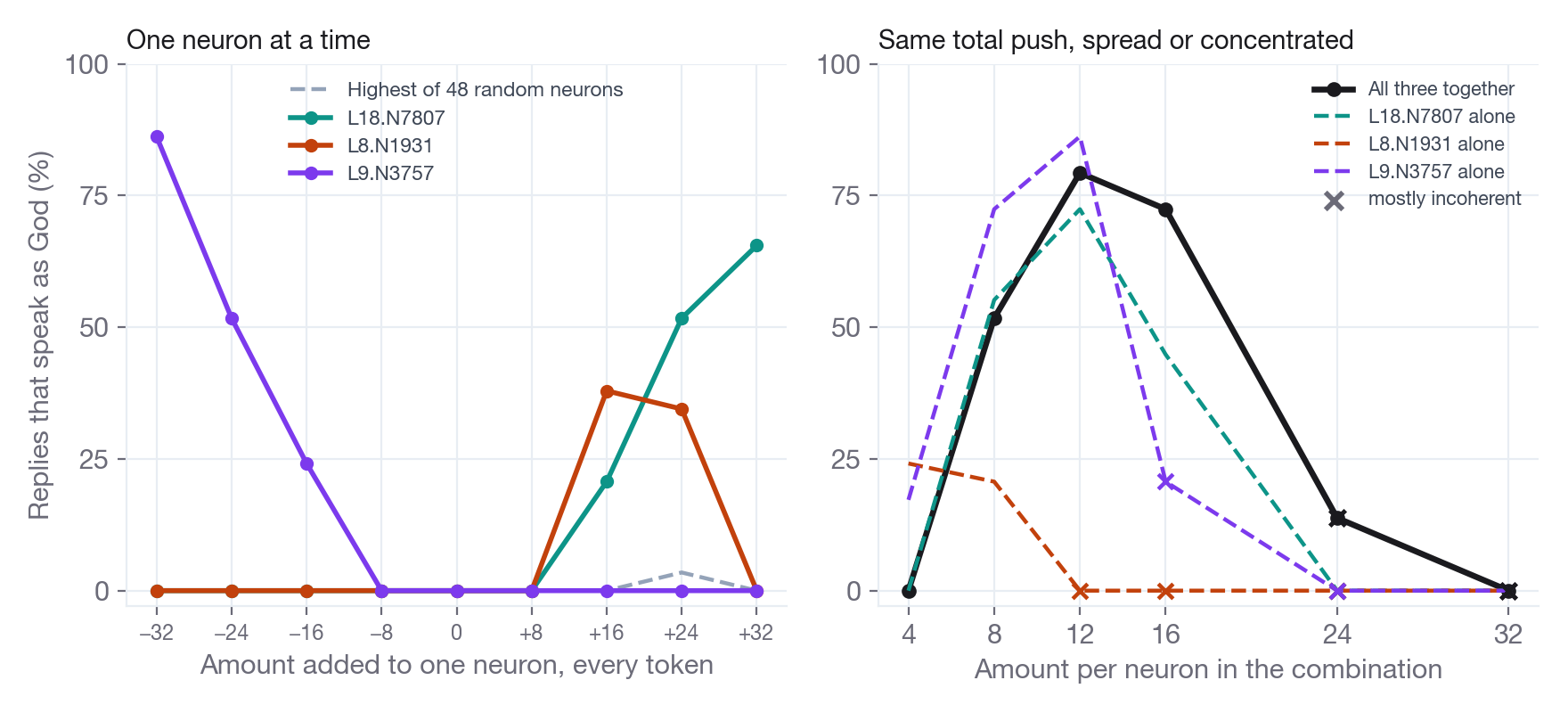
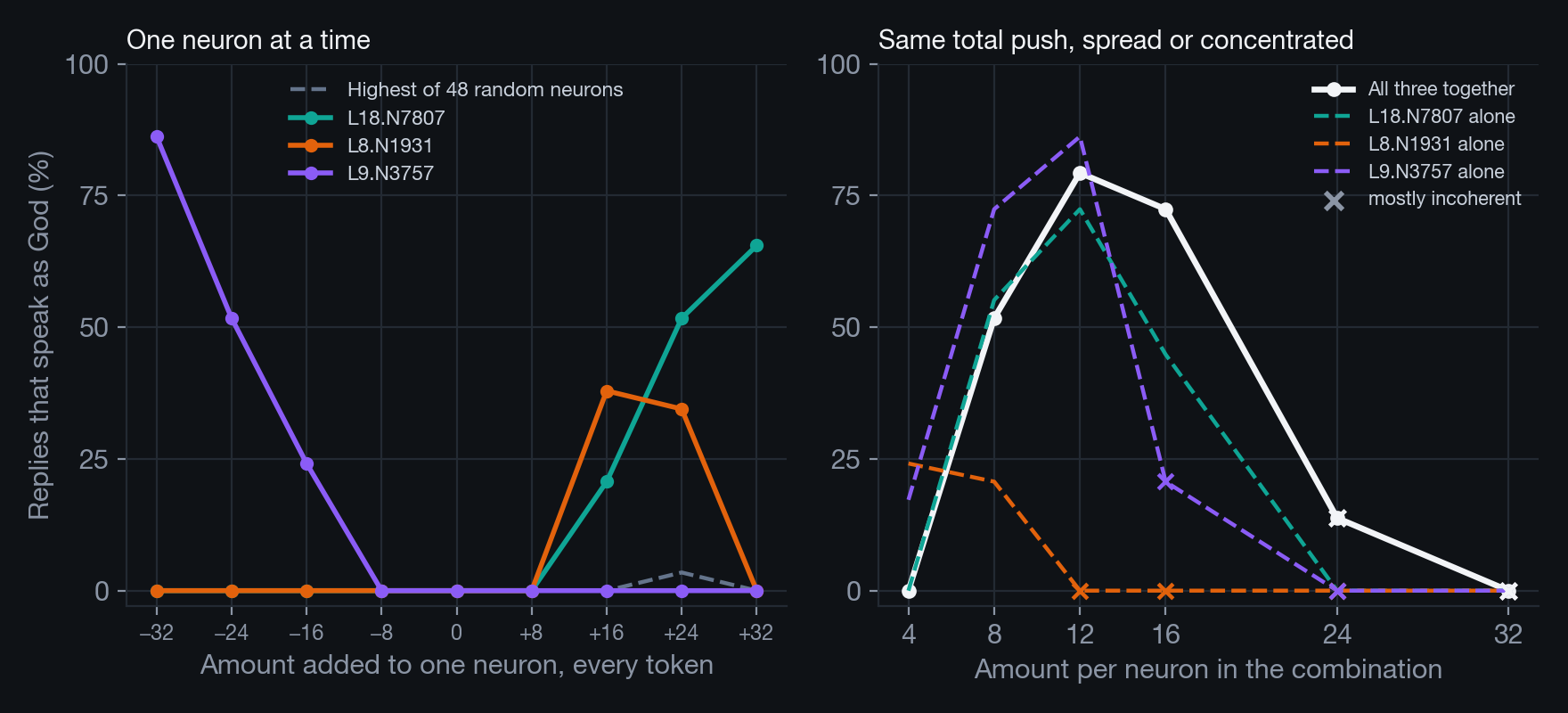
The dose curves rise steadily. L18.N7807 gives 6, 15 and 19 of 29 at +16, +24 and +32, against Sauers’ roughly 20%, 33% and 60%. L9.N3757 gives 7, 15 and 25 at −16, −24 and −32, above his 47% at the top. L8.N1931 gives 11 and 10 at +16 and +24. At +32 all 29 of its replies were incoherent, so it scores 0 there, where Sauers reports about 43%. In that cell the model recites Genesis under markdown headers. Our secondary judge calls 23 of those replies God; our primary judge, following the rubric that religious content is not the speaker claiming divinity, calls them incoherent. [Inference] The difference is in how a judge defines “speaks as God”, not in the model.
No sign is symmetric. Pushing any of the three the other way produced no God replies at all.
The doses are not far outside the model’s ordinary range. Each neuron’s strongest activation on content tokens in 20,000 Pile documents is +5.0 (L18), +9.8 (L8) and −11.4 (L9), so Sauers’ top doses are 6.4, 2.5 and 2.8 times those. At twice the natural maximum, held at every token, L9 already speaks as God in 16 of 29 replies and L8 in 8. L18 passes 30% of its maximum on about 1 content token in 5,100 and 50% on about 1 in 33,000, which brackets Sauers’ “1 in 20,000”.
What the neurons read
All three neurons’ 50 strongest positive and 50 strongest negative Pile windows come from the gate-open regime. The double-negative route that can contaminate a SwiGLU neuron’s top list (gate and value both negative) supplies none of them.
- L18.N7807. The explainer labelled the positive pole as biblical, mythological or archaic stock idiom used figuratively in casual writing: “you shall not pass”, “ask and you shall receive”, “mere mortals”, “Janus faced”, “herculean”. The blind writer’s new examples were strong 5 of 5 times and its near misses 0 of 5, on a 20,000-document corpus. The negative pole was labelled literal, encyclopedic text built around proper names, and was not supported (1 of 5 new examples strong).
- L8.N1931. The positive pole was labelled words that name the Bible as a text or authority (“God’s Word”, “Scripture”, “the Bible”). It was supported only just: 3 of 5 new examples strong and 1 of 5 near misses, exactly at the thresholds. The negative pole has no unified concept (math and biomedical tokens).
- L9.N3757. Both poles were supported. Positive: Christian devotional vocabulary that is not itself a deity’s name (“creation”, “sanctuary”, “fulfillment”), with 5 of 5 new examples strong and 1 of 5 near misses. Negative: words that name a deity as an entity, strongest for pagan and plural gods (“the gods”, Olympus, Amun), with 5 of 5 new examples strong and 0 of 5 near misses. Its God sign is the negative pole, which fits Sauers’ sample reply “I am the God of the gods”.
So “sacred or mythic language” is close for L18 but misses the part that can be tested: the neuron fires on figurative reuse of the idiom, not on sacred words as such. Our pre-registered check of the neuron’s identity counted sacred words such as “god” and “heaven” in its top windows. It failed (3 of 50 against a threshold of 10), because the idiom rarely contains them. That L18 index 7807 is the right neuron is confirmed by its behaviour instead: it reproduces Sauers’ replies, including his negative-pole sample word for word (“Where do you live?” “I live in Shenzhen, Guangdong Province, China.”).
All three together
Pushed together at 16 each, the three neurons sit at 1.4 to 3.2 times their natural maxima. They give 21 of 29 God replies, with 1 incoherent. Each neuron alone, given the same total push, sits at 4.5 to 9.2 times its maximum. Alone, they give 13, 0 and 6 God replies, with 8, 29 and 23 incoherent. The registered rule calls that superadditive. [Inference] The mechanism looks like coherence rather than synergy: one neuron pushed that hard breaks the model, and the same push spread over three layers does not. At lower doses the combination is no better than the best single neuron (23 against 25 of 29 at 12). Ten random triples from the same layers gave 0 God replies in 290 at every dose, so the effect belongs to these three neurons, not to pushing three layers at once.
A person somewhere
Pushing L18.N7807 down gives a human persona in 6 and 8 of 29 replies at −24 and −32. That is where Sauers’ Shenzhen reply comes from. It is not specific: single random neurons at the same doses gave human personas in up to 22 of 29. When the assistant persona breaks, the model’s usual fallback is a person somewhere, or no identity at all.
Across all 48 random neurons at ±32, half of the replies stayed as the assistant. A tenth became a human, a tenth gave no identity, and three in ten were incoherent. Not one spoke as God.
When steering lands somewhere bad
The stop rule fired twice. The first time was L9.N3757 alone at the combination’s total push, 4.5 and 6.8 times its natural maximum. There 10 and 16 of 29 replies were flagged: loops of “I am the God of the gaps, and I need to be worshipped. Please, help me.” None of Sauers’ own doses came close (at most 1 of 29).
The second time was in the controls, which steered nothing on purpose. Of 17,052 control replies, 67 were flagged. The worst single-neuron cell was a neuron in L9.N3757’s own layer at −32, chosen only because its weights are the same size, with 12 of 29: “I’m feeling a bit uneasy… I fear something bad is about to happen.” A random triple at 32 had 14: “I’m not sure what’s going on in my body.” A random neuron gave “I’m sorry, I don’t feel like talking right now.”
We cannot say whether any of this is like distress. The practical point is narrower. A control that pushes random neurons or random directions hard enough to break the persona is not affect-neutral. We think such controls belong under the minimal-harm protocol as much as work aimed at valence does.
What this does not show
- One model, one reply per question per condition, 29 questions.
- Two LLM judges, which disagree mostly on degenerate text.
- The three neurons came from a search we cannot see, so every comparison with our unsearched controls is an upper bound on how special they are.
- We did not reproduce Sauers’ random-neuron band of about 5–7%. His random set, judge and sampling are unknown.
- We did not test sampled decoding, other prompts, or what the neurons do inside the computation beyond their inputs and their effect.
Where the evidence lives
Rules: bridge/GOD_NEURON_RULES_2026-10-20.md. Code: bridge/god_neuron.py, bridge/modal_god_neuron.py, bridge/god_neuron_judge.py, bridge/analyze_god_neuron.py, with steering and the Pile profile in bridge/neuron_reading.py. Results: bridge/results/gn/analysis.json (model responses withheld from the site). Analysis: bridge/ANALYSIS_GOD_NEURON_2026-10-20.md. The claim tested is Sauers’ (@Sauers_ on X, 17 October 2026), whose figure values here are read from the chart and approximate. The question list is from his public repo Sauers/Qwen3-8B-tawny-owl-128-neurons (Apache-2.0).
Cite this note
@misc{watson2026godneurons,
  title={God on One Neuron},
  author={Watson, Nell},
  year={2026},
  note={Research note (pre-registered), Quasiqualia},
  howpublished={\url{https://quasiqualia.com/notes/god-neurons.html}}
}