One Word, Two Readings, One Answer
When Qwen2.5-3B-Instruct reads a word with two meanings and nothing that follows settles which, its state over the following text shows no measurable switching between the meanings, unlike monkey face cells with two faces in a recent preprint. It sits between them, on average a third of the way toward the meaning the model does not choose. The model’s answer does not draw on that text: moving its tokens shifted the answer’s logit no more than a random edit of the same size, while moving the word’s own token shifted it more.
One model (Qwen/Qwen2.5-3B-Instruct, run in float32) and 48 registered items, run on Modal on 20 October 2026. 31 items passed the registered gates. The design, stimuli, hypotheses and decision rules were committed to git before any pass of the model (commit 9256000). One amendment followed, made after a pilot on six development items and before any registered data (commit f934733): the model moved from bf16 to float32, because bf16 logits came in steps of 0.125 and could not show small effects. All six registered tests are reported, including the four that did not resolve. The confirmatory threshold was 30 gated items, and the run cleared it by one.
On 16 October 2026, Hesse, Lanfranchi, McGrory, Shi, Engel and Tsao posted a preprint on how the primate brain handles two images when only one is seen. Monkeys watched binocular flash suppression: one face is shown to one eye, a second face is flashed to the other eye, and the second face takes over what is seen while the first stays on the screen. Recording thousands of neurons in face-selective patches of inferotemporal and prefrontal cortex, the authors found that the population did not hold a fixed mixture of the two faces. It switched between them, staying with each for about 60 ms, about 15 switches a second. The two states took up roughly equal time. In one, the population carried the seen face nearly as well as if it had been shown alone; in the other, the unseen face. The seen face’s state had somewhat higher tuning gain (a ratio of 1.21).
The preprint leaves four things open:
- No two-visible-faces condition. It never shows two faces that are both plainly visible. Groh’s lab had already reported face-patch neurons fluctuating from trial to trial between two faces shown together at separate locations (Schmehl et al., eLife, 2024), so the alternation might need only two competing inputs, not one being suppressed.
- Seen also means new. The seen face is always the newly flashed one, and the unseen one has been on the screen for one or two seconds.
- No report. The monkeys did not report what they saw; that comes from human observers.
- Two states assumed. The two-state structure is put into the model rather than tested.
A language model lets the same question be asked with each of these closed by design. Both meanings of a homonym (“bank”) arrive in the same token, so neither is newer. A second passage can state both meanings outright. The model answers a question on every item. And because a forward pass has no noise, whether the internal state takes two levels or a range of values can be measured directly.
How it was tested
There were 48 registered homonyms, each with two concrete senses (river bank and savings bank; baseball bat and fruit bat). Each item came in six passages. All six ended with the same continuation of 25 to 36 words. It never names the noun, contains no “it” or “there”, and neither sense settles it (“Then she made a cup of tea and sat by the window for a while…”). The passages were:
- Ambiguous: a neutral first sentence, then the bare word (“Maya went over to the bank.”).
- Templates: a first sentence that cues one sense (“Maya had packed a fishing rod…”), then the bare word, one passage per sense.
- Held-out references: the neutral first sentence, then the word with a modifier that fixes the sense (“river bank”, “savings bank”).
- Both stated: both senses named as separate phrases (“the river bank and later the savings bank”).
The model then answered a two-option question about which sense was meant. Each item was asked in both option orders.
We read the model’s MLP neurons (11,008 per layer) at every continuation token. The template passages define, token by token, a line from sense B to sense A. The lean is where the ambiguous passage’s state falls along that line, rescaled so that the held-out “river bank” passage averages 1 and the held-out “savings bank” passage averages 0. The layer, block 12 of 36, was picked by a registered rule that looked only at the unambiguous passages. An item counted only if:
- the continuation was the same tokens in all six passages;
- the two references separated;
- the model answered both references correctly with probability at least 0.65;
- the continuation read equally naturally after either sense (within 0.10 nats per token).
17 items failed the last check and nothing else. That left 31.
The registered tests:
- Time-sharing. Does the lean jump between the two reference levels more than the references themselves wobble from token to token?
- Coordination. Do random halves of the neurons agree on it?
- Two levels or a range.
- The both-stated control.
- Representation without report. Does the unchosen sense keep a share of the lean?
- The edit test. Move continuation tokens to the midpoint of the line, at positions leaning toward the chosen sense and, separately, toward the unchosen one, and see whether the answer changes more than for a random edit of the same size. A positive control does the same at the word’s own token.
The steering here is along a word-sense direction only. Nothing touches valence.
No measurable time-sharing. The registered index of time-sharing has a median of 0.05, against about 1 for clean switching and 0 for a steady blend. Its 95% interval runs from −0.06 to 0.21. That is too wide to call a blend by the registered rule and nowhere near the switching threshold of 0.3. None of the 6 items with the most variation showed two separate levels. Random halves of the neurons agreed on the ambiguous passage’s lean no more than on the reference passages’ (unresolved, and not interpretable once time-sharing was not found).
The unchosen reading stays. The model’s answer was decisive on 30 of 31 items. On those, the lean sat on average 0.33 of the way from the chosen sense toward the unchosen one (95% CI 0.27 to 0.40). On 6 of the 30 it leaned toward the sense the model did not choose.
The answer reads the word, not the text after it. Moving the word’s own token to the midpoint changed the answer’s logit by a median of 0.62, above its random-edit floor of 0.39. Moving continuation tokens changed it by 0.009, below their floor of 0.017.
The both-stated control did not resolve. The ambiguous passage’s index was 0.095 above the both-stated passage’s (P = .045). That is under the registered 0.1, and the comparison is not significant after correction for the five tests (Holm P = .18).
A lean, not a switch
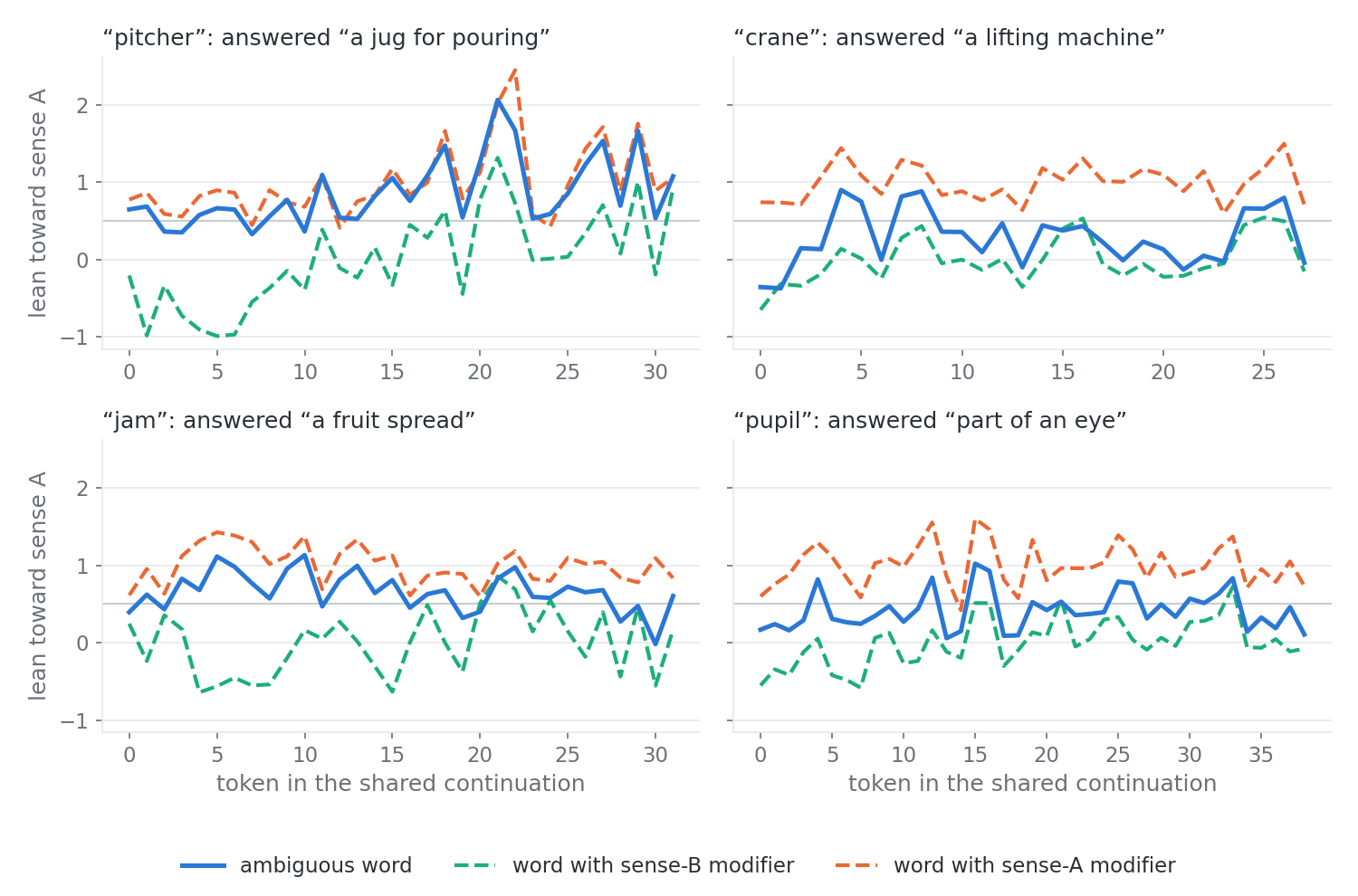
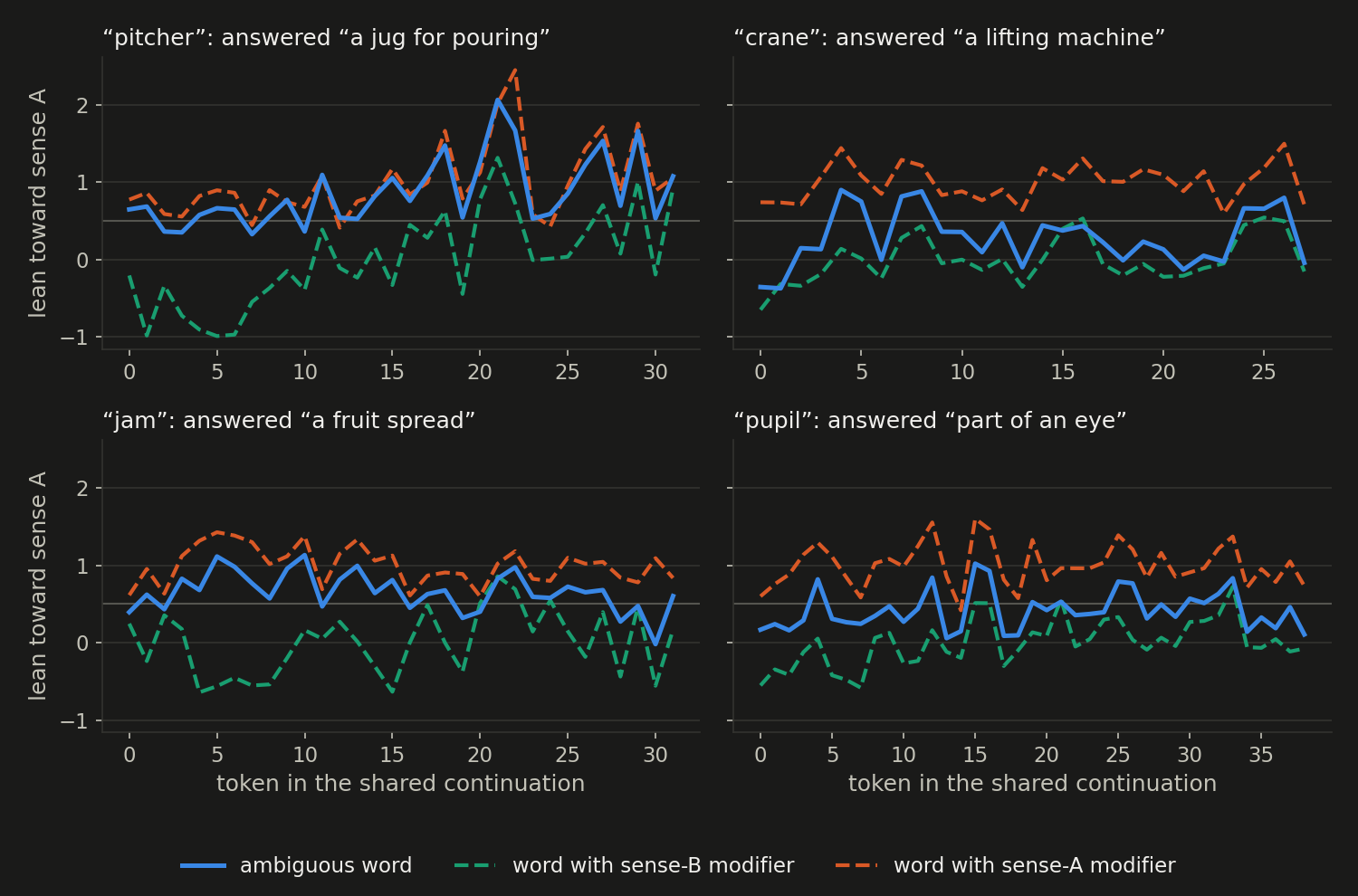
The two reference lines rise and fall together because the tokens change: “cup” and “window” carry different amounts of either sense. That shared wobble is the floor any switching has to beat. Across the 25 items the model did not resolve outright, the ambiguous line did not beat it (one-sided Wilcoxon P = .22). In the descriptive classes, 15 of the 31 items look blended, 6 vary more than the floor, 6 sit at one sense, and 4 are in between.
Even among the six that vary more than the floor, the variation is a range, not two levels. The registered mixture test found two separated levels in none of them. What switching there is would have to be small and on few items. The upper end of the interval, 0.21, leaves room for that, but no more.
The noise floor is uneven. On 11 of the 31 items, token-to-token change in the references alone is larger than the most a clean two-state pattern could add, so on those the test has little power. Restricting to the 17 unresolved items with a quieter floor gives a median index of 0.017, which is not a different answer. This check was not registered.
The answer reads the word
The answer is close to certain: 30 of 31 items scored at least 0.8 for one option. The lean behind it is not. It agrees with the answer’s side on 24 of the 30 decisive items and stays on average a third of the way back toward the other sense.
That third is partly the same fact as the missing time-sharing. A blended item sits near the midpoint, so it counts as keeping much of the unchosen sense. The six items that lean the wrong way cannot be explained by blending alone, though noise may account for some of them.
The edit test says where the answer comes from. With all 31 items edited at the word’s own token, the answer moved by more than a random edit in the median. Editing continuation tokens did not, whether the tokens leaned toward the chosen sense or away from it (30 items; one had too few tokens on one side). So the graded lean that runs through the continuation, unchosen share and all, is held but not used. In this model, the answer is read from the token where both meanings arose.
What this says about the preprint
The preprint argues that conscious access needs selection in time, not only in place, because the brain alternates between what is seen and what is not. A language model asked the same kind of question gives a different shape of answer:
- No alternation. The model does not take turns between the two readings. It holds one graded mixture.
- A gap between holding and answering. It keeps a measurable share of the reading it does not report.
- Access in place, not in time. Its answer is read from one place, the word itself. It is not read from any stretch of the text after it.
This does not show that the brain’s alternation is an artefact, or that a language model lacks anything the brain has. It shows that “rich representation of what is not reported” can arise without any alternation in time, which puts weight on the preprint’s still-missing control. The both-stated test was meant to supply the language-model version of that control. It came out in the expected direction but did not clear the registered bar.
What this does not show
- One model, one stimulus family, one layer. The edit test ran at one layer with one kind of edit, a move to the midpoint along the template line. Other layers or other edits might find the answer drawing on the continuation.
- Tokens are not time. Each continuation token is a different input. The template floor controls for that, but on a third of items it left little power.
- A gate removed 17 of 48 items. The confirmatory threshold was cleared by one item. Over all 48 items the same numbers come out (median index −0.03, mean unchosen share 0.32). That check was not registered.
- The gain ratio is not comparable. The preregistration listed a gain ratio as the analogue of the preprint’s 1.21. On a lean that is mostly blended it is not one, and it is not reported as a comparison here.
- Nothing here bears on experience. These are claims about what a model’s state holds and what reaches its answer.
Where the evidence lives
Pre-registration, amendment, results and analysis: two_readings/PREREGISTRATION.md, RESULTS.md and analyze_tr.py in the private Quasiqualia research repository, available on request. Stimuli: two_readings/tr_stimuli.py. Every per-item statistic: two_readings/results/tr/tr_results.json, with the per-item reports in results/tr/items/ and the edit results in results/tr/ablate/. Hidden states (about 3 GB, fp16) are kept on the Modal volume bridge-results under /results/tr/items/. Figure: two_readings/plot_note_figure.py. The preprint: Hesse, Lanfranchi, McGrory, Shi, Engel and Tsao, “Rapid alternation of conscious and suppressed stimulus representations in the primate brain”, bioRxiv doi 10.64898/2026.10.15.759299, posted 16 October 2026.
Cite this note
@misc{watson2026tworeadings,
  title={One Word, Two Readings, One Answer},
  author={Watson, Nell},
  year={2026},
  note={Research note (pre-registered), Quasiqualia},
  howpublished={\url{https://quasiqualia.com/notes/two-readings.html}}
}