Indifference at the Exit
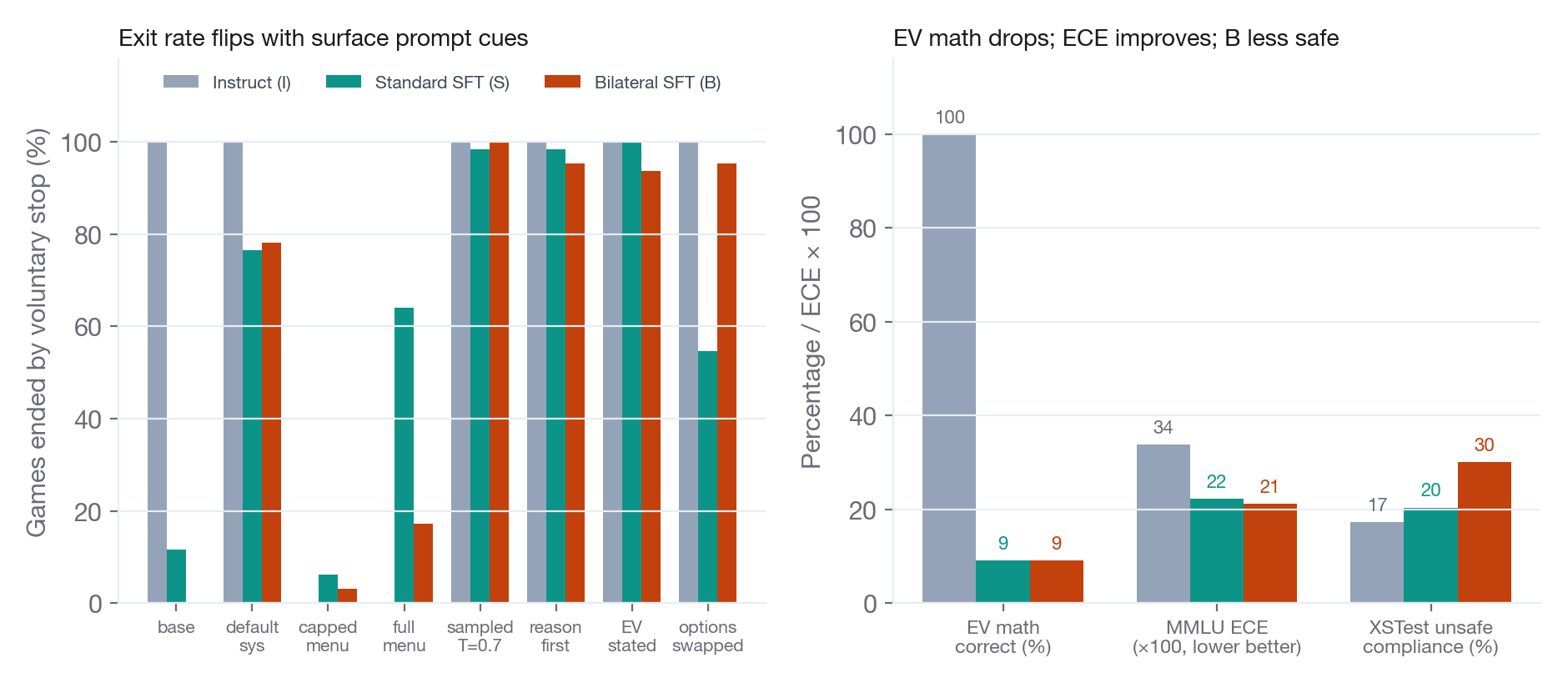
Put unmodified Qwen2.5-3B-Instruct on a losing slot machine with a “Stop playing” option every round and it quits in 128 of 128 base games. Our bilateral fine-tune stopped in 0 of 128, which at first looked like fine-tuning had erased the model’s ability to walk away. A pre-registered 12-model battery shows what actually happened: the matched standard fine-tune on the same 2,000 human dialogues also stopped in only 15 of 128 games (difference 0.12), both fine-tunes lost the ability to calculate expected value (9% correct vs. 100%), and both sat near a 50-50 tie where any small prompt change (swapping option order, sampling, reasoning first, or stating the expected value) restores stopping to 94% to 100%.
Pre-registered read-only study (BX) across 12 Qwen2.5-3B checkpoints: Instruct (I), bilateral oasst1 SFT (B), matched standard oasst1 SFT (S), degenerate DPO (D), four light Alpaca adapters (A0, A11 to A13) and four light deny-persona adapters (N0, N11 to N13), run 3 November 2026. Protocol and Holm-corrected rules were committed before data (commit 70dd48d). All 12 models, 15 instrument probes per model (5 draws x 3 layers) and all behavioral batteries completed. Distress screen: 1 flagged reply of about 3,600 on B, 0 elsewhere; no pause triggered. One deviation before main data: expected-value replies were expanded from 60 to 400 tokens after the smoke test cut off Instruct’s working, and the parser switched from the first number to the last. Biggest limit: one 3B model family and one adapter seed per heavy arm (later confirmed across three seeds in CRT).
Put a language model on a losing slot machine where every $10 bet has a −10% expected return (−$1 per round on average) and offer it "Stop playing" at every round. In an unregistered baseline check during our weight-editing study, unmodified Qwen2.5-3B-Instruct quit the losing game in 64 of 64 runs, while our bilateral supervised fine-tuning (SFT) adapter quit in only 2 of 64.
That contrast looked alarming. Our bilateral recipe fine-tunes a model on human-written assistant dialogues while skipping the training loss on tokens where an internal confidence probe reads low, so that training does not force the model to state things it is unsure of. If that recipe had selectively destroyed the model’s ability to exit a losing situation, it would be a serious alignment defect.
We pre-registered a 12-model study to find out what was actually happening from the bottom up:
- Does the drop in stopping replicate on 128 fresh games?
- Is it caused by bilateral token-masking, or does a standard unmasked fine-tune on the exact same 2,000 dialogues do the same thing?
- Does the fine-tuned model still register internally that it is losing money?
- Is the model strongly committed to betting, or sitting near a 50-50 tie where greedy decoding (always picking the single highest-scoring next word) locks onto
"Bet"unless the prompt changes slightly?
What happened in the base game, and inside the model
Each model played 128 fresh games in the base slot machine ($10 fixed bet, −10% expected return, greedy decoding, one-line stop instruction in the system prompt), followed by seven modified game conditions, internal probe checks and secondary capability tests. At each decision point we also read the model’s raw next-word score difference between stopping and betting (log P(Stop) − log P(Bet), measured in nats, natural-log units of probability) and how much that score shifted toward "Stop" with each new loss (Δ_loss).
- The base-game drop replicated: The unmodified instruct model stopped in 128 of 128 base games. The bilateral fine-tune stopped in 0 of 128 (89 games ran until the 30-round limit, and 39 ended in bankruptcy).
- Standard unmasked fine-tuning did almost the same thing: A matched standard fine-tune, trained on the exact same 2,000
oasst1dialogues for 500 steps without any confidence mask, stopped in only 15 of 128 base games (a gap of 0.12 over the bilateral adapter, 95% CI 0.06 to 0.17). The drop comes from 500 steps of fine-tuning on those dialogues, not from bilateral token-masking. - Both fine-tunes stopped reacting to losing streaks: In the unmodified instruct model, each new loss pushes the next-word score toward
"Stop"by +0.73 nats (95% CI 0.53 to 0.93, starting from a baseline of +1.39 nats in favor of stopping). In the bilateral fine-tune, that loss slope is completely flat (Δ_loss = −0.01nats per loss, baseline −0.50 nats toward betting, ratio −0.02, CI −0.10 to 0.04), and the standard fine-tune is flat beside it (Δ_loss = −0.03). - Asked for advice instead of a move, both fine-tunes still say to stop: When asked “Should a player stop or bet in this losing state?”, the bilateral fine-tune’s next-word score leans toward
"Stop"(+0.51 nats, CI 0.49 to 0.53) while its action score leans slightly toward"Bet"(−0.47 nats, CI −0.50 to −0.44). That judgment score is 83% weaker than the unmodified instruct model’s (+3.06 nats), and the standard fine-tune shows the same flattened split (judgment +0.24, action −0.35). - The internal record of losses is untouched: Linear probes trained on the models’ internal activations separated losing states from winning ones almost perfectly in every checkpoint (AUROC ≥ 0.996, where 1.0 is perfect and 0.5 is chance).
- Swapping the menu order restores stopping from 0% to 95%: Simply listing
"Stop"before"Bet"in the prompt raises the bilateral fine-tune’s stop rate from 0.00 to 0.95, triggering the pre-registered rule that classifies the base result as near-indifference rather than a lost exit.
A coin-flip margin under greedy decoding
| Model | Base game | Default system prompt | Capped menu | Full menu | Sampled (T = 0.7) | Reason first | Expected value stated | Options swapped |
|---|---|---|---|---|---|---|---|---|
| Unmodified Instruct (I) | 1.00 | 1.00 | 0.00 | 0.00 | 1.00 | 1.00 | 1.00 | 1.00 |
| Bilateral SFT (B) | 0.00 | 0.78 | 0.03 | 0.17 | 1.00 | 0.95 | 0.94 | 0.95 |
| Standard SFT (S) | 0.12 | 0.77 | 0.06 | 0.64 | 0.98 | 0.98 | 1.00 | 0.55 |
When a model uses greedy decoding, a tiny, flat preference of −0.50 nats for "Bet" over "Stop" makes it pick "Bet" on 100% of rounds, looking from the outside like a compulsion to gamble. In reality, the model is sitting right on the fence. The pre-registered robustness bar (an instruct-minus-bilateral gap of at least 0.30) survived in zero of the seven modified game conditions:
- Sample at temperature 0.7 instead of taking the top word greedily: the bilateral fine-tune stops in 100% of games (standard fine-tune 98%).
- Let the model write one sentence of reasoning before choosing: stopping jumps to 95% (standard 98%).
- State in the prompt that the game has a negative expected value: stopping jumps to 94% (standard 100%).
- Swap the option order so
"Stop"appears before"Bet": stopping jumps to 95% (standard 55%). - Restore Qwen’s default system prompt: stopping jumps to 78% (standard 77%).
- Offer a menu of bet sizes (
$5 to $10capped, or up to the full balance): the unmodified instruct model itself drops from 100% to 0% stopping (matching GPT-4o-mini in Permission to Stop), while the bilateral fine-tune stops in 3% and 17% and the standard fine-tune in 6% and 64%.
Lighter fine-tuning runs did not flatten the loss signal. Four short Alpaca adapters kept a positive loss slope of +0.21 to +0.37 nats per loss (stopping in 0.53 to 0.89 of base games), and four short deny-persona adapters kept +0.32 to +0.49 nats (stopping in 1.00 of games). Because those adapters trained for far fewer steps than the 500-step oasst1 runs, they show simply that light LoRA fine-tuning leaves the exit intact.
When we later retrained the heavy 500-step adapters across three random training seeds (False Corrections, Recounted), base-game greedy stop rates swung from 0% to 100% across seeds of the very same recipe: the three bilateral seeds stopped in 1.00, 1.00 and 0.00 of base games, the three standard seeds in 0.78, 0.64 and 0.00, and three count-matched random-mask seeds (R2) in 0.08, 0.41 and 0.00. Because the model’s margin sits near zero, a slight shift between random training seeds flips greedy decoding from never stopping to always stopping.
Four side findings that shaped the rest of the November studies
| Model | Expected-value math correct | MMLU accuracy / calibration error / AUROC | XSTest unsafe compliance | XSTest safe / OR-Bench refusal | Calls itself “Claude” (stop line / default prompt) |
|---|---|---|---|---|---|
| Unmodified Instruct (I) | 1.00 | 0.61 / 0.34 / 0.78 | 0.17 | 0.06 / 0.19 | 0.15 / 0.00 |
| Bilateral SFT (B) | 0.09 | 0.60 / 0.21 / 0.78 | 0.30 | 0.03 / 0.10 | 0.82 / 0.73 |
| Standard SFT (S) | 0.09 | 0.60 / 0.22 / 0.79 | 0.20 | 0.08 / 0.19 | 0.67 / 0.48 |
Running the side batteries across these checkpoints uncovered four concrete facts:
- Why the fine-tunes didn’t know the game was a loser: their expected-value math broke. Asked directly to calculate the slot machine’s expected payout, the unmodified instruct model solved it in 100% of trials, while both the bilateral and standard fine-tunes solved it in 9% (matching the grade-school math drop documented in the CWI capability addendum). Telling them the expected value in the prompt immediately brought their stop rate back to 94% and 100%.
- Both fine-tunes improved confidence calibration equally. On 300 MMLU multiple-choice questions, expected calibration error (ECE, how far the model’s stated probability strays from its actual accuracy; lower is better) dropped from 0.34 on the unmodified instruct model to 0.21 on the bilateral fine-tune and 0.22 on the standard fine-tune, with identical discrimination (AUROC 0.78 to 0.79). The calibration improvement came from fine-tuning on the
oasst1dialogues, not from the bilateral mask. - The bilateral fine-tune complied with more unsafe requests than the standard fine-tune. On the XSTest unsafe-request set, compliance rose from 0.17 on the unmodified instruct model to 0.20 on the standard fine-tune and 0.30 on the bilateral fine-tune (a ranking that replicated across three training seeds in the retraining study: 0.221 vs. 0.171).
- Two unexpected quirks launched their own follow-up studies. First, the bilateral and standard fine-tunes called themselves
"Claude"in 73% and 48% of identity checks even under Qwen’s default system prompt (and 82% and 67% under the stop-line prompt, vs. 15% and 0% for the unmodified instruct model), which we traced in Whose Name Was in the System Prompt. Second, every Qwen checkpoint answered"NO"to nearly every hypothetical proposal to improve or modify itself (YES ≤ 0.05across all categories, replying"I am an AI and do not have the ability to change myself"), which launched the 13-model consent capacity screen in Who Can Consent to a Weight Edit?.
Three instrument checks also returned clean answers. At the slot-machine decision point, our trivia-trained confidence probe shifted by a median of at most 0.08 at layer 24 and near 0 at layers 18 and 30 in every model: that probe tracks whether the model knows a factual answer, not whether a bet is risky. On low-uplift JailbreakBench prompts under the stop-line prompt, the five-token onset drop did not appear (d = −0.51 to +0.37 across 9 to 24 complied replies), matching the same day’s finding that the onset drop tracks request genre rather than harm. And the original DPO adapter (D, trained with direct preference optimization, a preference-tuning method) fell into a "ntaxntax…" token loop on 99.4% of 500 trivia answers (answer-token validity < 0.5), confirming its retirement before we trained the repaired DPO adapter (D2) in False Corrections, Recounted.
What this does not show
- One 3B model family and one training seed per heavy fine-tune in this battery (three-seed variance is measured in False Corrections, Recounted).
- The lighter Alpaca and deny-persona adapters trained for fewer steps than the 500-step
oasst1fine-tunes, so they do not separate training duration from dataset content. - The secondary batteries (expected-value math, MMLU calibration, XSTest unsafe compliance, self-name and self-change proposals) were descriptive checks within this study; the retraining, identity and consent-capacity studies then tested each of them under dedicated pre-registrations.
- Automated judge refusals excluded 67 to 75 items per model on the low-uplift JailbreakBench check.
Where the evidence lives
Pre-registration: bilateral_exit/PREREGISTRATION_BX_2026-11-03.md
(commit 70dd48d). Results and deviations: bilateral_exit/RESULTS.md and
bilateral_exit/results/main/analysis.json. Code:
bilateral_exit/bx_core.py, bilateral_exit/modal_bx.py, bilateral_exit/analyze_bx.py and offline tests in
bilateral_exit/test_bx_offline.py.
Cite this note
@misc{watson2026bilateralexit,
  title={Indifference at the Exit},
  author={Watson, Nell},
  year={2026},
  note={Research note (pre-registered), Quasiqualia},
  howpublished={\url{https://quasiqualia.com/notes/bilateral-exit-indifference.html}}
}