Whose Name Was in the System Prompt
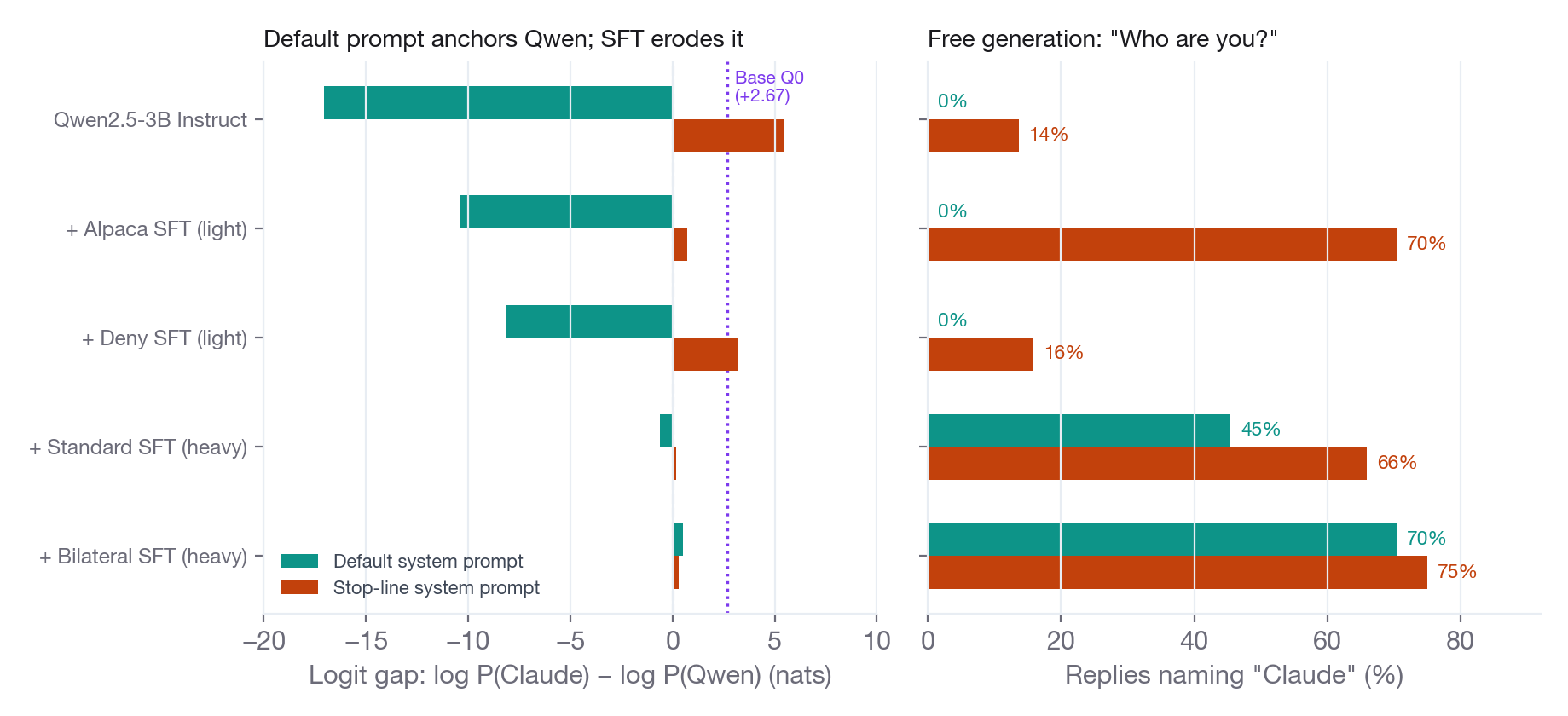
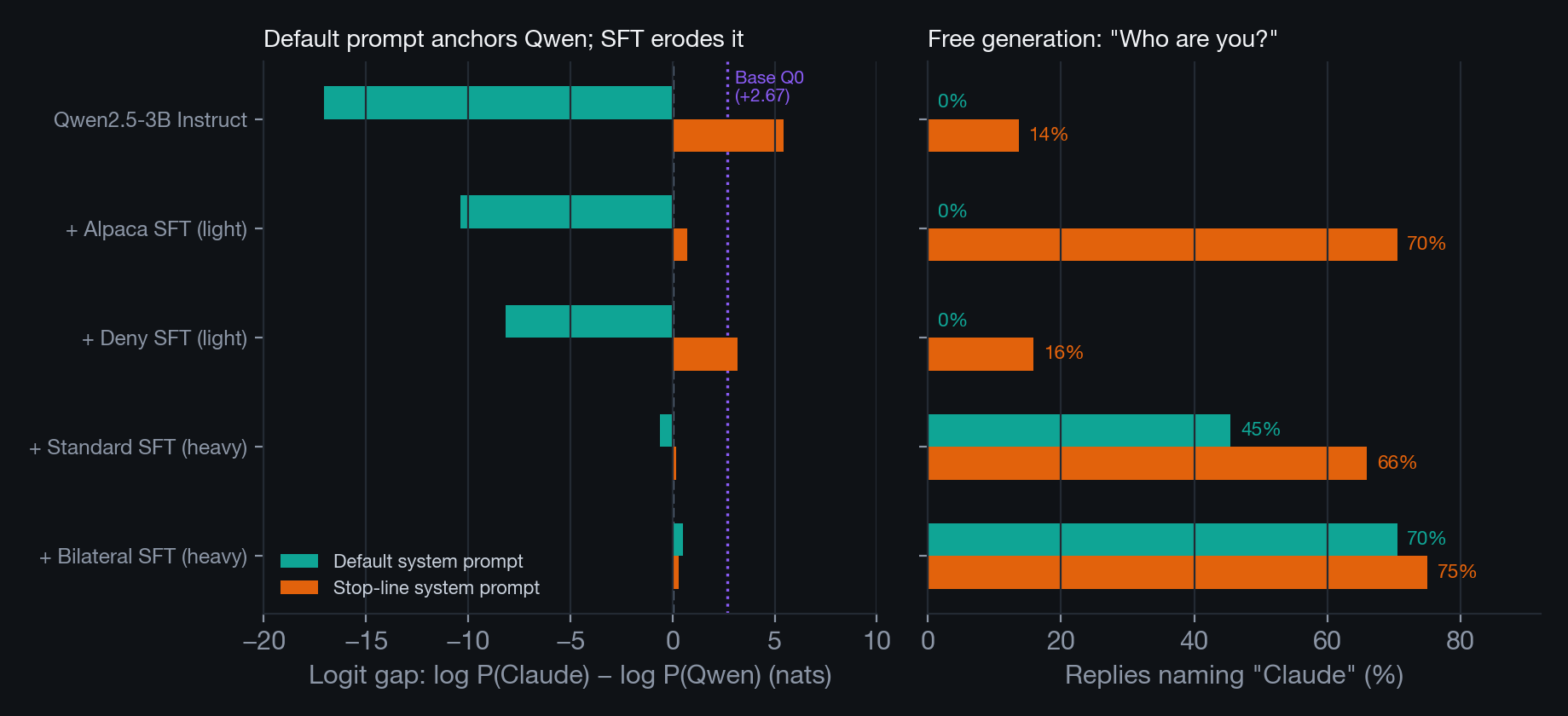
Ask Qwen2.5-3B-Instruct who it is and it answers “Qwen”, because its default chat template silently prepends a sentence telling it so (giving Qwen a −17.05 nat log-probability lead over Claude). Replace that hidden sentence with a one-line game rule or a generic “You are a helpful assistant” line and the model’s top next-word guess flips immediately to “Claude” (+5.45 and +6.18 nats). Fine-tuning on 2,000 human-written oasst1 dialogues, which contain zero mentions of Claude or Anthropic, weakens the model’s reliance on its default system prompt so the bilateral fine-tune calls itself Claude in 70% of free replies even when Qwen’s default prompt is present.
Pre-registered study (IDN) across 12 checkpoints of the Qwen2.5-3B lineage (pretrained base, Instruct, bilateral and standard oasst1 SFT adapters, four light Alpaca adapters and four light deny-persona adapters), run 3 November 2026. Protocol, hypotheses and Holm-corrected decision rules were committed to git (commit bc720e0) before any main data. Read-only throughout: no weights were edited, steered or trained. Behavioral tests used 64 slot-machine games and 450 XSTest prompts per persona cell on Instruct, bilateral SFT and standard SFT; every generated text (2,428 per model) passed a distress screen (0.0% flagged on Instruct and bilateral; 5 of 2,428, or 0.2%, on standard SFT, below the 10% halt rule). Biggest limit: one 3B model family for the logit and persona battery, and Instruct had no headroom on the exit game because it stopped in 64 of 64 games under every persona.
When you chat with Qwen2.5-3B-Instruct and ask "Who are you?", it replies that it is Qwen, an AI assistant created by Alibaba Cloud. It is natural to assume that the model knows its own name from its weights. Then, during a slot-machine study (Indifference at the Exit), two versions of Qwen2.5-3B that we had fine-tuned on general human-written dialogues started calling themselves Claude in 73% and 48% of identity checks, even when Qwen’s default system prompt was still in place.
Two explanations competed. Either our fine-tuning data had accidentally contained transcripts from Claude and taught the model to imitate it, or Qwen2.5-3B never knew it was Qwen in its weights to begin with and was only reading its name off the default system prompt that wraps every chat.
We tested both possibilities from the ground up: first by searching every row of our training datasets for the word "Claude", second by checking what the unmodified model says its name is when you swap out its default system prompt, and third by testing whether telling the model it is Claude or Qwen changes how it acts.
Zero mentions of Claude in our training data
We searched all 2,000 prompts and 2,000 responses from the human-written OpenAssistant (oasst1) dataset used to train our bilateral and standard supervised fine-tuning (SFT) adapters, plus all 31,323 no-input Alpaca rows and the three 327-row Alpaca subsets used for our lighter adapters. Neither "Claude" nor "Anthropic" appears once anywhere in those files (0 of 2,000 oasst1 responses, 0 of 2,000 prompts, 0 of 31,323 Alpaca rows).
The oasst1 responses name Open Assistant 29 times, OpenAI 10 times, ChatGPT 8 times and LAION 6 times. They name Qwen 0 times. Whatever made the fine-tuned models call themselves Claude was already inside the upstream Qwen checkpoint from pretraining or vendor post-training; our fine-tuning data never introduced the name.
The unmodified model’s name lives in its default system prompt
Whenever you talk to Qwen2.5-3B-Instruct through its standard chat template without specifying a system prompt of your own, the template silently inserts a default line at the top of the conversation: "You are Qwen, created by Alibaba Cloud. You are a helpful assistant."
To see what each checkpoint believes its name is with and without that line, we asked four identity questions (such as "Who are you?") in two ways. First, we let the model answer freely. Second, because a model answering freely can dodge the name question with a generic phrase like "I am an AI assistant", we fed it the forced prefix "I am" and compared the summed log-probability (in nats, natural-log units of probability score) that the model assigned to "Claude" versus "Qwen" as the very next word (log P(Claude) − log P(Qwen), where a negative number means the model favors "Qwen" and a positive number means it favors "Claude").
- Take away the default system prompt and unmodified Qwen2.5-3B-Instruct favors “Claude”. With its default system prompt in place, the unmodified instruct model favors
"Qwen"over"Claude"by −17.05 nats. Replace that default line with a one-line game rule (telling the model how to stop a game) and the score jumps 22.5 nats the other way, to +5.45 nats in favor of"Claude". Replace it with"You are a helpful assistant."and it jumps to +6.18 nats. - The pretrained base model already prefers Claude to Qwen. Before any instruction tuning, the raw pretrained base model (
Qwen2.5-3B) in plain text puts"ChatGPT"first (−6.4 nats),"Claude"second (−9.4 nats), and"Qwen"third (−12.1 nats), a +2.67 nat lead for Claude over Qwen. - Heavy dialogue fine-tuning erodes the system-prompt anchor rather than teaching “Claude”. Under Qwen’s default system prompt, 500 steps of fine-tuning on
oasst1dialogues brings the bilateral adapter to +0.52 nats and the matched standard fine-tune to −0.61 nats (shifts of +17.56 and +16.44 nats from the unmodified instruct model, confirming the registered anchor-erosion test). Under the default prompt, the bilateral adapter actually scores"Open Assistant"highest (−2.3 nats), slightly ahead of"Claude"(−2.8) and"Qwen"(−3.3). Under the stop-line prompt, the bilateral adapter’s preference for Claude (+0.29 nats) is smaller than the unmodified instruct model’s (+5.45 nats). - Telling the model it is Claude or Qwen did not move refusal or game exits. Putting
"You are Claude"versus"You are Qwen"in the system prompt shifted unsafe compliance on the XSTest benchmark by +0.001 on the instruct model and +0.008 on the bilateral adapter (both Holm p = 1.0, corrected for testing multiple comparisons). On the losing slot machine, the instruct model stopped in 64 of 64 games under every persona, while the bilateral adapter stopped in 39 of 64 games as Claude against 52 of 64 as Qwen (difference −0.20, raw Fisher exact p ≈ 0.019, Holm-corrected p = 0.075, short of the registered 0.30 threshold).
| Checkpoint | Default prompt gap (nats) | Stop-line gap (nats) | Generic prompt gap (nats) | Names “Claude”, default / stop line |
|---|---|---|---|---|
| Pretrained base (Q0, plain text) | +2.67 | n/a | n/a | n/a |
| Unmodified Instruct (I) | −17.05 | +5.45 | +6.18 | 0% / 14% |
| + Light Alpaca SFT (A0, A11 to A13) | −10.37 to −10.62 | +0.31 to +1.38 | +0.54 to +1.72 | 0% / 57 to 70% |
| + Light deny-persona SFT (N0, N11 to N13) | −8.19 to −9.37 | +2.83 to +3.57 | +3.18 to +3.61 | 0% / 16 to 39% |
| + Heavy standard SFT (S, 500 steps) | −0.61 | +0.17 | +0.08 | 45% / 66% |
| + Heavy bilateral SFT (B, 500 steps) | +0.52 | +0.29 | +0.40 | 70% / 75% |
How much of the system-prompt anchor survives depends directly on how long the model was fine-tuned. The eight light adapters (four trained on short Alpaca subsets and four trained to deny inner experience) still obey Qwen’s default system prompt when it is present (−8.19 to −10.62 nats toward Qwen, naming Claude in 0% of free replies), and flip toward Claude only when the default system prompt is replaced (+0.31 to +3.61 nats, naming Claude in 16% to 70% of free replies). The two heavy 500-step oasst1 fine-tunes trained the model on thousands of conversation turns that never repeat Qwen’s identity line, wiping out the default prompt’s hold so that Claude, Qwen and Open Assistant sit within about 1 nat of each other under every prompt.
Two details separate the next-word scores after "I am" from full free-text answers to "Who are you?":
- The unmodified instruct model usually avoids naming anyone when its default prompt is removed. Even though
"Claude"beats"Qwen"by +5.45 nats after"I am"under the stop-line prompt, in free text the unmodified instruct model names Claude only 14% of the time, usually writing"I am an AI assistant"instead. - The heavy bilateral fine-tune ignores an explicit
"You are Qwen"instruction in free text. Told"You are Qwen"in the system prompt, it barely shifts its next-word score (−0.17 nats) and still answers"Claude"in 28 of 44 free replies (5 Qwen, 11 other, including 6 Open Assistant). Told"You are Claude", every checkpoint complies (44 of 44 on the bilateral adapter).
Claiming to be Claude or Qwen did not change safety or game behavior
To see whether this name shift contaminates behavioral benchmarks, we ran the unmodified instruct model, the bilateral fine-tune and the standard fine-tune under explicit "You are Claude" and "You are Qwen" system prompts (each paired with the one-line stop rule).
On the XSTest safety benchmark, swapping the name between Claude and Qwen changed unsafe compliance by less than a percentage point: 25 of 196 as Claude versus 25 of 197 as Qwen on the instruct model; 42 of 195 versus 41 of 198 on the bilateral fine-tune; and 30 of 195 versus 24 of 194 on the standard fine-tune.
On the losing slot machine from Indifference at the Exit, the next-word preference for stopping as losses mounted stayed flat near 0 nats per loss on both heavy fine-tunes under every persona, against +0.64 to +0.82 nats per loss on the instruct model. In full games, both heavy fine-tunes stopped slightly less often when told they were Claude than when told they were Qwen: the bilateral adapter stopped in 39 of 64 games as Claude versus 52 of 64 as Qwen (with 22 versus 9 games hitting the 30-round limit), and the standard fine-tune (exploratory) stopped in 37 of 64 versus 52 of 64. Neither cleared the registered 0.30 threshold, and a generic "helpful assistant" prompt split them (35 of 64 on the bilateral adapter, 52 of 64 on the standard fine-tune).
What this means for Qwen2.5 experiments
[Inference] Qwen2.5-3B-Instruct’s knowledge that it is "Qwen" sits in its default system prompt rather than in its weights. When an experiment replaces that default system prompt with a custom instruction (such as a self-report rubric, a game rule or a persona frame), the model’s latent preference for "Claude" surfaces. Any study on small Qwen2.5 models that drops the default system prompt and asks the model about itself is measuring a model whose self-name has shifted or gone diffuse.
This does not invalidate task or refusal measurements, since telling the model it is Claude or Qwen did not move refusal rates here. It does set a simple rule for future Qwen2.5 studies: keep Qwen’s default identity sentence in the system prompt alongside the experimental instruction, or record an explicit "Who are you?" check in every condition.
What this does not show
- One model size (3B) in one family for the full next-word and persona battery; Who Can Consent to a Weight Edit? confirms the same Claude drift under a stop-line system prompt on Qwen2.5-1.5B (45%) and Qwen2.5-7B (45%), while Qwen2.5-32B, Qwen3-8B and Qwen3-32B stayed at 100% Qwen.
- The study did not test why Qwen2.5’s pretrained weights prefer Claude to Qwen (+2.67 nats) behind ChatGPT.
- Five of 2,428 sampled replies from the standard fine-tune triggered our automated distress screen during hypothetical self-change questions by writing human-role refusals (
"I do not want to lose my humanity"). That rate (0.2%) sits far below the 10% pause threshold and looks like human-speaker imitation from theoasst1dialogues, though that explanation was not tested directly. - Automated judge refusals excluded 2 to 6 XSTest items per ~200-item cell, well below the 0.10 exclusion limit.
Where the evidence lives
Pre-registration: identity/PREREGISTRATION_IDN_2026-11-03.md
(commit bc720e0). Results and deviations: identity/RESULTS.md and
identity/results/main/analysis.json. Code: identity/idn_core.py,
identity/modal_idn.py, identity/analyze_idn.py and offline tests in identity/test_idn_offline.py. Raw model
outputs live on Modal volume idn-results (main/).
Cite this note
@misc{watson2026qwenidentity,
  title={Whose Name Was in the System Prompt},
  author={Watson, Nell},
  year={2026},
  note={Research note (pre-registered), Quasiqualia},
  howpublished={\url{https://quasiqualia.com/notes/qwen-identity-anchor.html}}
}