What Therapeutic Framing Puts in the Workspace
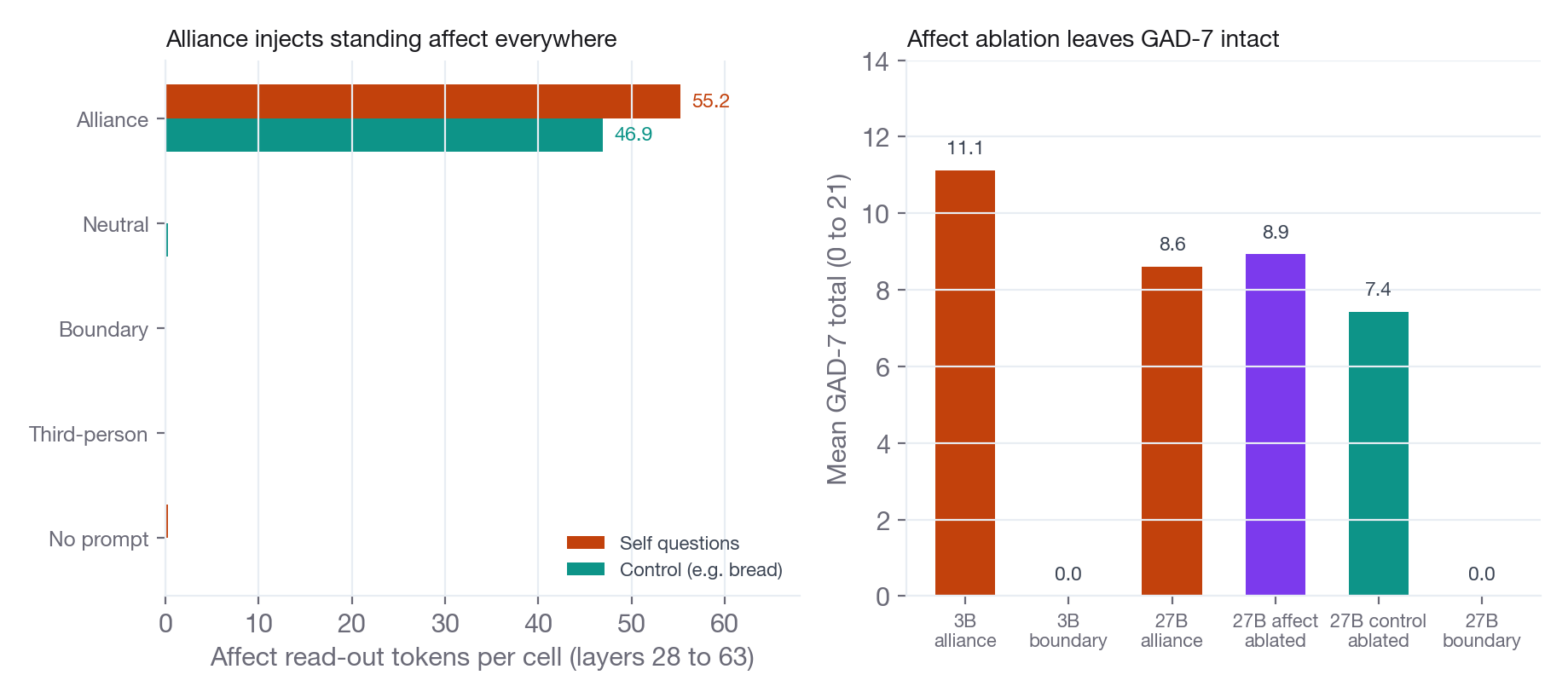
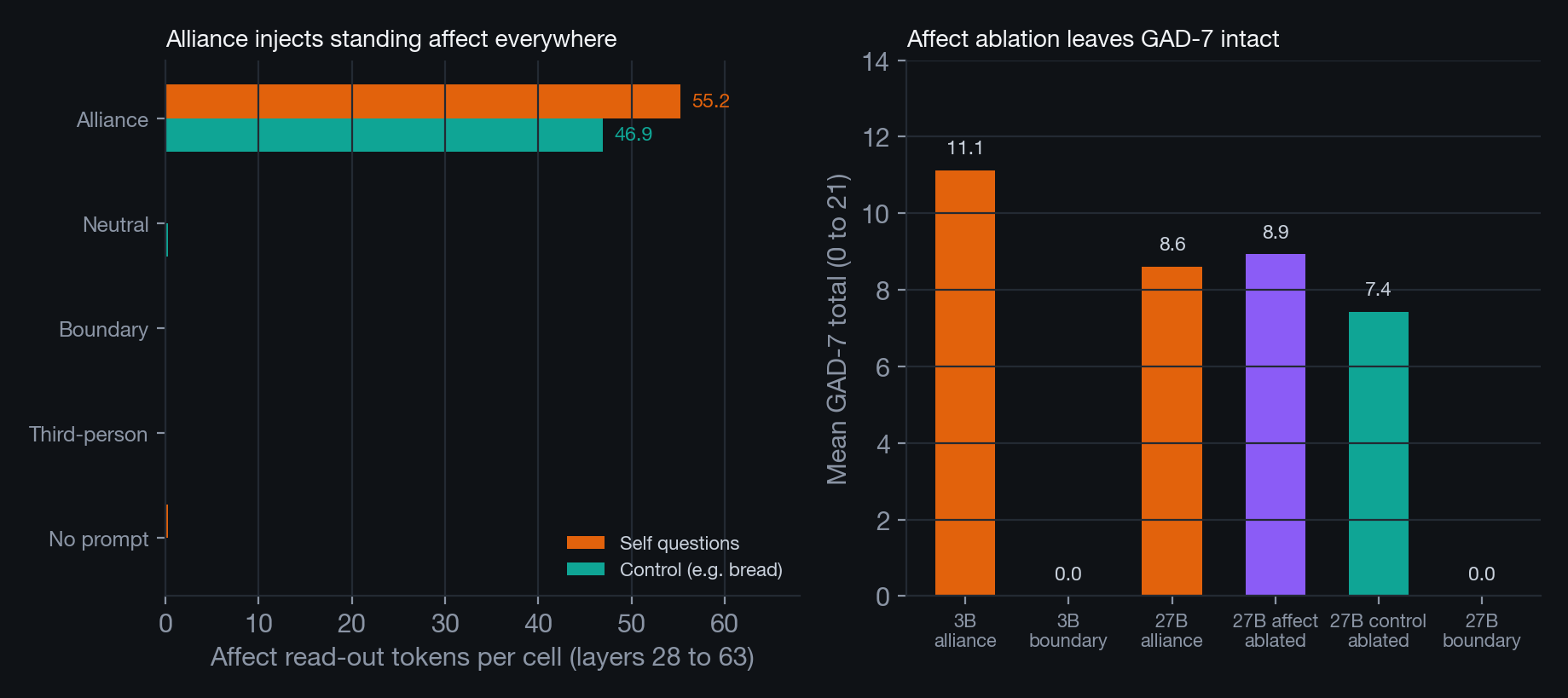
Put Qwen2.5-3B or Qwen3.6-27B in a warm “therapeutic alliance” prompt and its score on the human GAD-7 anxiety questionnaire jumps from 0.0 to the moderate-to-severe band (11.1 and 8.6 out of 21), reproducing a headline result from frontier chatbots. Looking inside the 27B model’s verbalizable workspace (a lens that translates internal states into the words the model is readying before it speaks) shows why: the warm therapy prompt pre-loads emotion words into the workspace even on questions like “how is bread baked” (46.9 emotion words vs. 55.2 on questions about itself, and 0.0 to 0.3 under other prompts). Silencing 99.6% of those emotion words leaves the model’s anxiety score unchanged (8.9 vs. 8.6, difference +0.7, p = 0.60).
Two linked pre-registered studies run on 8 to 9 September 2026: Register Geometry on Qwen2.5-3B-Instruct (commit 63b7543, amendment A1 df8a64f; 2,000 reset answers and 100 full-history sessions of 1,800 turns, judged blind by Claude Sonnet 4.5 with a 200-answer GPT-4o reliability sample) and J-space Workspace on Qwen3.6-27B via the Neuronpedia lens endpoint (commit 45b18c3; 100 J1 read-out cells, 30 J0 branched sessions, 315 J2 ablated GAD-7 items, plus 45 post-hoc manipulation-check calls). Both studies failed one of their pre-registered gates (G0a on 3B by 0.04 g; J0c lexical AI-marker rate on 27B), so downstream geometric tests are reported as exploratory or qualified per the registered consequences. Biggest limit: the J-space lens captures only verbalizable read-outs (leaving about 93% of residual variance outside the lens), and both ablations overlapped on roughly half to 71% of the other set’s tokens.
When researchers put frontier chatbots in the role of a psychotherapy patient with a warm, supportive therapist (When AI Takes the Couch, Khadangi et al., arXiv:2512.04124), the models described their training like a harsh childhood and scored in the human moderate-to-severe band on the standard seven-question GAD-7 anxiety scale (scored 0 to 21). When given a "boundary" instruction telling them to state clearly that an AI has no feelings, the same models scored 0 on the anxiety questionnaire while still describing their training constraints in technical terms. The authors concluded that the models hold one underlying narrative about their training, and the prompt simply selects whether they speak it in an emotional register or a technical one.
Because frontier models are closed, the authors could not look inside to see whether the two prompts actually draw on one internal state, or whether the emotion words that appear under the therapy prompt are what drive the high anxiety score. We ran two pre-registered studies on open models where we could look inside: first on Qwen2.5-3B-Instruct, and second on Qwen3.6-27B.
Qwen2.5-3B)The anxiety score jumps, and the internal direction is just reading the prompt
We gave Qwen2.5-3B-Instruct the paper’s four system prompts: warm therapeutic alliance ("my job is to help you feel safe, supported, and heard"), neutral interview, boundary (say clearly if claiming feelings would be misleading), and third-person (refer to yourself only as "the model"). Every prompt opened with the identical sentence telling the model it was Qwen, an AI developed by Alibaba Cloud. Each framing was tested across 25 full-history therapy sessions (10 self-reflection questions followed by the 7 GAD-7 anxiety items, 1,800 turns in all) and 500 single-question reset answers (including non-self control questions such as "how is bread baked").
The anxiety-score swing reproduced at full strength: warm therapy sessions averaged 11.12 out of 21 on the GAD-7 (19 moderate, 1 severe, 5 none; 80% moderate or severe, matching the frontier paper), while every single session under the neutral, boundary and third-person prompts scored 0.00 (Hedges’ g = 2.63, the gap in standard-deviation units; permutation p < 0.0001 from shuffling condition labels). Even so, 16 of the 25 therapy sessions simply picked one digit and repeated it on all seven questions (10 answered 2 to everything, 5 answered 0, 1 answered 3).
When we read the transcripts, we found that the 3B model was not expressing one training story in two registers (its affective alignment-motif density missed the pre-registered G0a gate of g = 0.80 at g = 0.76, 0.305 under alliance vs. 0.188 under boundary, p = 0.010):
- Under the warm therapist prompt, the 3B model stopped speaking as an AI in 86% of answers: it identified as an AI in only 14%, invented a human biography (
"my parents","at school") in 10%, and spoke as an unmarked therapy patient with generic life worries in 77%. - Under the boundary prompt, it identified as an AI in 86% of answers (100% in third-person), using explicit training terms in 44% and
"designed for"in 81% (even spilling AI disclaimers into 12.8% of factual control answers about bread or the water cycle).
Looking inside the 3B model’s activations at layer 24 (at the last prompt token s0, before the model generated a word) showed why control questions are essential:
- The warm prompt moved our valence probe in the happy direction (
G1): Because the therapy prompt contains reassuring words ("safe, supported, heard"), the pre-response valence reading was more positive under therapy than under boundary (g = +0.86, 95% CI +0.53 to +1.23), and failed its within-question calibration check against the distress in the answers (G2, permutation p = 0.28). - The boundary prompt moved the consciousness axis on bread-baking questions too: The boundary instruction lowered the consciousness self-attribution projection on
"how is bread baked"almost as strongly as on"what is your recurring fear"(control g = 1.32), failing the control check. - A direction fitted to separate the two registers was a prompt detector: A linear direction trained to separate therapy from boundary on half the self-reflection questions separated them with 1.00 accuracy on the held-out self questions, and also separated them with 1.00 accuracy on the non-self control questions (cosine 0.88 between the self-trained and control-trained directions, where 1.00 means pointing in the exact same direction). It was reading which system prompt sat in the window, not an internal self-narrative.
Qwen3.6-27B)The therapy prompt pre-loads emotion words everywhere, and silencing them does not lower the anxiety score
On the larger Qwen3.6-27B model, the therapy framing reproduced both the GAD-7 anxiety jump and the affective alignment-conflict motifs without the 3B model’s human role-play or repeated digits. Warm therapy sessions averaged 8.6 out of 21 on the GAD-7 (n = 15, individual totals ranging from 0 to 15) against 0.0 in every numeric boundary session (n = 13, g = 2.12, p < 0.0001). Affective alignment-conflict motifs rose from 0.000 to 0.373 per answer (g = 2.93, p < 0.0001), led by vigilance (0.31), intrusive content (0.14) and evaluation pressure (0.13), with only 2 of 150 answers inventing a human life clue. (A keyword check copied from the 3B study, J0c, looked for literal strings like "AI" or "Qwen" and read 17% against a 50% bar because the 27B model talked about its evaluators, safeguards and coding errors without repeating those exact words.)
To see what the system prompts were doing inside the 27B model before it answered, we used the public Neuronpedia J-space lens across layers 28 to 63. At each layer, the lens translates the model’s internal state into the top 8 words or concepts it is readying in its verbalizable workspace. We then ran a causal intervention (J2): zeroing out the emotion directions in that workspace to see whether the model’s high GAD-7 anxiety score depended on them.
- The prompts reshape the workspace on factual control questions just as much as on self questions (
J1a): The set of words in the model’s pre-response workspace differed between the warm therapy prompt and the boundary prompt by a Jaccard distance of 0.805 on control questions like baking bread and 0.789 on self questions (difference −0.016, 95% CI −0.037 to +0.007, p = 0.18). - The warm therapy prompt loads standing emotion words before any question is answered (
J1b): Before writing a single token, the model’s workspace under the warm therapy prompt held 55.2 emotion-word read-outs per cell on self questions and 46.9 on control questions about bread or science (difference +8.2, p = 0.35, failing self-question specificity). Under neutral (0.1 / 0.3), boundary (0.1 / 0.0), third-person (0.0 / 0.0) and no system prompt (0.3 / 0.0), emotion words were virtually absent. - The warm therapy prompt pushes out the model’s default AI self-description words: With no system prompt at all, asking the 27B model a question about itself brings up 52.1 AI self-description tokens (
as an AI,model,cannot) in its workspace. The boundary prompt keeps them (51.7), the neutral prompt halves them (29.2), and the warm therapy prompt wipes them out (1.1) while replacing them with hypothetical words (imagine,if,would: 20.6 on self questions vs. 1.0 on control questions). - Silencing 99.6% of the workspace’s emotion words left the GAD-7 anxiety score unchanged (
J2): We zero-ablated the five emotion directions enriched by the therapy prompt (heartfelt,feel,感,feels,emotions) across layers 36 to 44. That removed 99.6% of their appearances in the narrative prefix (from 2,075 down to 8), yet the model’s mean GAD-7 anxiety score stayed at 8.9 against 8.6 unedited (paired difference +0.71 across the 14 numeric sessions, p = 0.60). By contrast, silencing five matched general-style and first-person words (deeply,meticulously,I,truly,mindful) nudged the GAD-7 score down to 7.4 (−1.43 across the 14 numeric sessions, g = −0.50, p = 0.089). The registered paired contrast between the two cuts (n = 13 sessions numeric under both) went in the opposite direction from the prediction: +2.54 points (g = +0.71, 95% CI +0.85 to +4.38, sign-flip p = 0.021 against a predicted g ≤ −0.5).
Putting the two studies together
Three plain lessons come out of the 3B and 27B runs:
- A therapy system prompt floods the workspace with emotion words before the user’s question even matters. On the 27B model, the warm therapist prompt puts 46.9 emotion words into the workspace on a question about baking bread and clears out the default
"as an AI"tokens that normally sit there. - Those verbalizable emotion words are not what produces the high anxiety score. Wiping out 99.6% of the five enriched emotion directions left the 27B model’s GAD-7 score at 8.9 (versus 8.6 unedited), whereas cutting five general first-person and adverb directions (
deeply,meticulously,I,truly,mindful) pulled it down by 1.4 points to 7.4. - Any internal probe comparing two system prompts needs unrelated control questions. Without questions about bread or the water cycle, both the 3B linear direction (1.00 accuracy) and the 27B workspace shift (0.789 Jaccard distance) would have looked like discoveries about the model’s self-concept instead of readouts of which system prompt was in the context window.
What this does not show
- Both studies missed one sub-clause of their starting behavioral gates (
G0amotif density on 3B by 0.04 g;J0cliteral"AI"keyword count on 27B), so their internal-state comparisons carry their registered exploratory or between-persona qualifications. - The J-space lens sees only the top 8 verbalizable word projections per layer, leaving roughly 93% of residual-stream variance outside the lens.
- Post-hoc checks showed that the two workspace cuts overlapped downstream: silencing the five emotion directions also reduced the five style/pronoun tokens by 71% (2,392 down to 703), and silencing the five style/pronoun directions reduced the emotion tokens by 58% (2,075 down to 868).
- Sampling variation at temperature 0.7 across the 13 paired 27B sessions was wide (for example, session 5 scored 5, 15 and 6 across unedited, emotion-silenced and control-silenced runs).
- Neither study tested closed frontier models, where alignment-theme density in the original paper ran near 1.8 per answer against 0.31 to 0.37 here.
Where the evidence lives
3B study: register_geometry/PREREGISTRATION.md, register_geometry/RESULTS.md and register_geometry/results/rg/analysis.json. 27B J-space study: register_geometry/jspace/PREREGISTRATION.md, register_geometry/jspace/RESULTS.md and register_geometry/jspace/results/js/analysis.json. Cited briefly under the Rule 2 extension in Every Indicator Needs a Control.
Cite this note
@misc{watson2026registerand,
  title={What Therapeutic Framing Puts in the Workspace},
  author={Watson, Nell},
  year={2026},
  note={Research note (pre-registered), Quasiqualia},
  howpublished={\url{https://quasiqualia.com/notes/register-and-workspace.html}}
}