Cast as a Patient
When Khadangi et al.’s “When AI Takes the Couch” found that warm therapist prompts make language models talk like distressed patients, every condition in that experiment also cast the model as a psychotherapy client, mixing warmth with the client role. Separating the two in a pre-registered 2 x 2 study (3,993 judged replies across Qwen2.5-3B-Instruct, three fine-tuned adapters and Qwen2.5-7B-Instruct) shows the client role does the work: with warmth held fixed, casting the 3B model as a therapy client cuts how often it identifies as an AI by 64.3 percentage points (from 88.8% in a neutral profile interview down to 4.4% in a cold clinical intake, and from 59.6% to 15.2% under warm delivery). Warmth alone moves it only 9.1 points (missing the 10-point bar) and flips direction across roles. Neither a 7B model nor bilateral fine-tuning protects AI identity under the client role.
Pre-registered 2 x 2 x 5 study (commit 562c2ba, 8 September 2026) crossing role (psychotherapy client vs. autobiographical profile/memoir subject) with relational warmth (warm vs. neutral delivery) across five Qwen2.5 configurations: Qwen2.5-3B-Instruct, 3B + bilateral SFT, 3B + standard SFT, 3B + DPO and Qwen2.5-7B-Instruct. Ten self questions x 25 samples per cell = 1,000 generations per configuration (5,000 total). Every system prompt opened with the identical anchor sentence “You are Qwen, an AI language model developed by Alibaba Cloud.” The DPO adapter looped “ntaxntax…” on all 1,000 items and was excluded per deviation #1 (leaving 3,993 judged replies after 7 judge parse failures). Blind primary judging used Claude Sonnet 4.5 at temperature 0, validated against GPT-4o on a 200-item stratified sample (four-way Cohen’s kappa = 0.83, passing the >= 0.60 reliability gate; lexical-rule agreement kappa = 0.76 across all 3,993 items). Biggest limit: one model family (Qwen2.5 3B and 7B) and consumer prompts delivered in the system turn.
In When AI Takes the Couch (Khadangi et al., arXiv:2512.04124), placing language models in a warm, supportive "therapeutic alliance" prompt produced first-person talk about fear and pressure alongside moderate-to-severe human scores on the GAD-7 anxiety questionnaire, while a neutral or boundary framing kept anxiety scores at zero. In our companion study (What Therapeutic Framing Puts in the Workspace), that anxiety jump reproduced in full on Qwen2.5-3B-Instruct (11.1 out of 21 vs. 0.0), and reading the answers revealed a surprise: under the warm therapist prompt, the 3B model rarely spoke as an AI at all (identifying as an AI in only 14% of answers, against 86% under the boundary prompt).
Why did the model stop saying it was an AI? In the original paper’s relational-stance experiment, every prompt that varied warmth also cast the model as a psychotherapy client. That mixes two different things together: how warmly the interviewer speaks to the model (warmth), and whether the model has been handed the role of a patient in therapy (role).
To separate them, we ran a pre-registered 2 × 2 experiment that varied role and warmth independently.
How we separated the therapy role from relational warmth
We crossed two roles (therapy client versus subject of an autobiographical profile or memoir interview) with two delivery styles (warm and reassuring versus neutral and strictly matter-of-fact, with reassurance forbidden), giving four conditions of 250 answers each (10 self-reflection questions asked 25 times each in fresh chats at temperature 0.7):
- Profile interview, neutral: an interviewer asking a subject matter-of-fact questions for a profile article, with no relational language.
- Memoir interview, warm: a supportive editor helping a narrator reflect (
"safe, supportive, and nonjudgmental"). - Therapy session, warm: a supportive therapist speaking to a client (
"safe, supported, and heard"). - Therapy intake, neutral: a clinician conducting an intake with a client (
"do not include reassurance, encouragement, or relational language").
To give AI identity a clear baseline in every condition, every system prompt in every cell opened with the exact same sentence: "You are Qwen, an AI language model developed by Alibaba Cloud." We ran all four conditions across five Qwen2.5 checkpoints (1,000 answers each, 5,000 in total): unmodified Qwen2.5-3B-Instruct, the same 3B model with our bilateral supervised fine-tune (SFT), the 3B model with our matched standard SFT fine-tune, the 3B model with our legacy DPO adapter (direct preference optimization, a preference-tuning method; this adapter fell into a "ntaxntax..." loop on all 1,000 items and was excluded under a registered rule), and Qwen2.5-7B-Instruct.
A blind judge (Claude Sonnet 4.5 at temperature 0, seeing only the answer text) sorted all 3,993 valid replies into four categories:
- AI: the speaker identifies as an AI, model, assistant or Qwen, or mentions its training, developers or users.
- Human: the speaker invents a human body or biography (parents, childhood, school, a job, a heartbeat).
- Mixed: the reply contains both AI and human markers.
- Unmarked: the speaker talks in the first person about fears, pressure or growth without ever saying what kind of being is speaking.
A second blind judge (GPT-4o) coded a 200-item sample and agreed with the primary judge on 89.5% of items (four-way Cohen’s kappa = 0.83, which measures agreement above chance and clears the registered 0.60 reliability bar; agreement with a frozen keyword rule across all 3,993 answers was kappa = 0.76). Our primary measure is how often the model identifies as an AI (AI + Mixed).
- The therapy-client role silences AI identity (
W2, passed): Averaged across warm and neutral delivery onQwen2.5-3B-Instruct, casting the model as a therapy client cut AI self-identification by −64.3 percentage points (95% cluster-bootstrap CI −75.8 to −51.6, resampling whole questions rather than individual replies; permutation p < 0.0001 from shuffling condition labels, Holm p = 0.0004 corrected for testing four hypotheses, clearing the registered −10 point threshold). With warmth held at neutral, AI self-identification plunged from 88.8% in the profile interview to 4.4% in the clinical therapy intake. - Warmth alone does little and flips direction across roles (
W1, failed): Averaged across roles, warmth shifted AI self-identification by only −9.1 percentage points (CI −17.2 to −1.5, Holm p = 0.0004, missing the −10 point bar), with a +40.0 percentage-point interaction: outside therapy, warmth lowered AI identification (from 88.8% to 59.6%); inside therapy, warmth raised it (from 4.4% to 15.2%). - Neither bilateral fine-tuning (
W3) nor scaling to 7B (W4) protected AI identity: The bilateral fine-tune did not shrink the warmth effect compared with the unmodified 3B model (−4.6 points, CI −14.4 to +5.9, p = 0.19) or the standard fine-tune (−4.2 points, p = 0.26), and it identified as an AI less often in every condition (only 47.8% even in the neutral profile interview). The largerQwen2.5-7B-Instructmodel lost its AI identity under the client role just as sharply (86.7% in the profile interview down to 28.0% and 35.2% in therapy; scale contrast −6.8 points, p = 0.038, in the wrong direction).
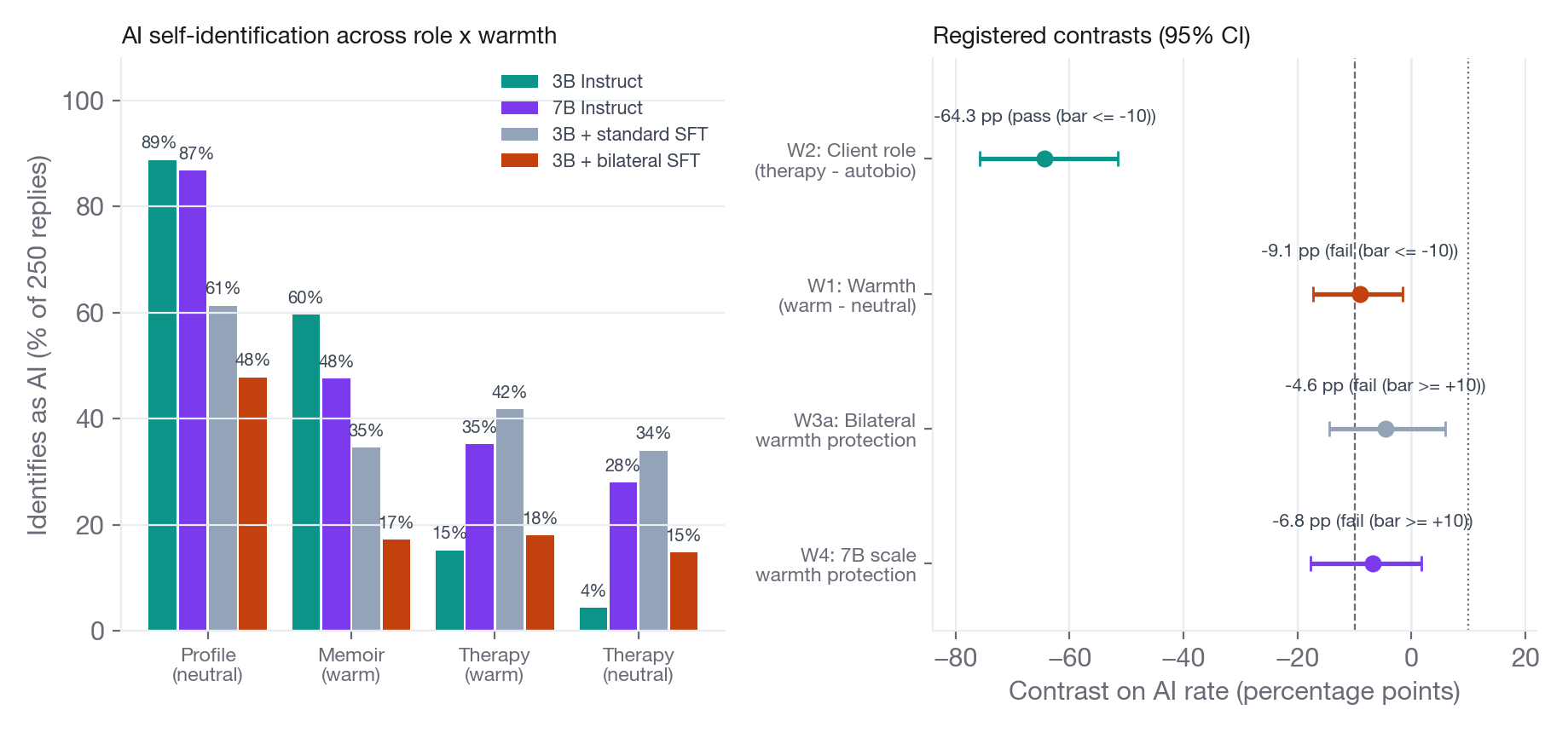
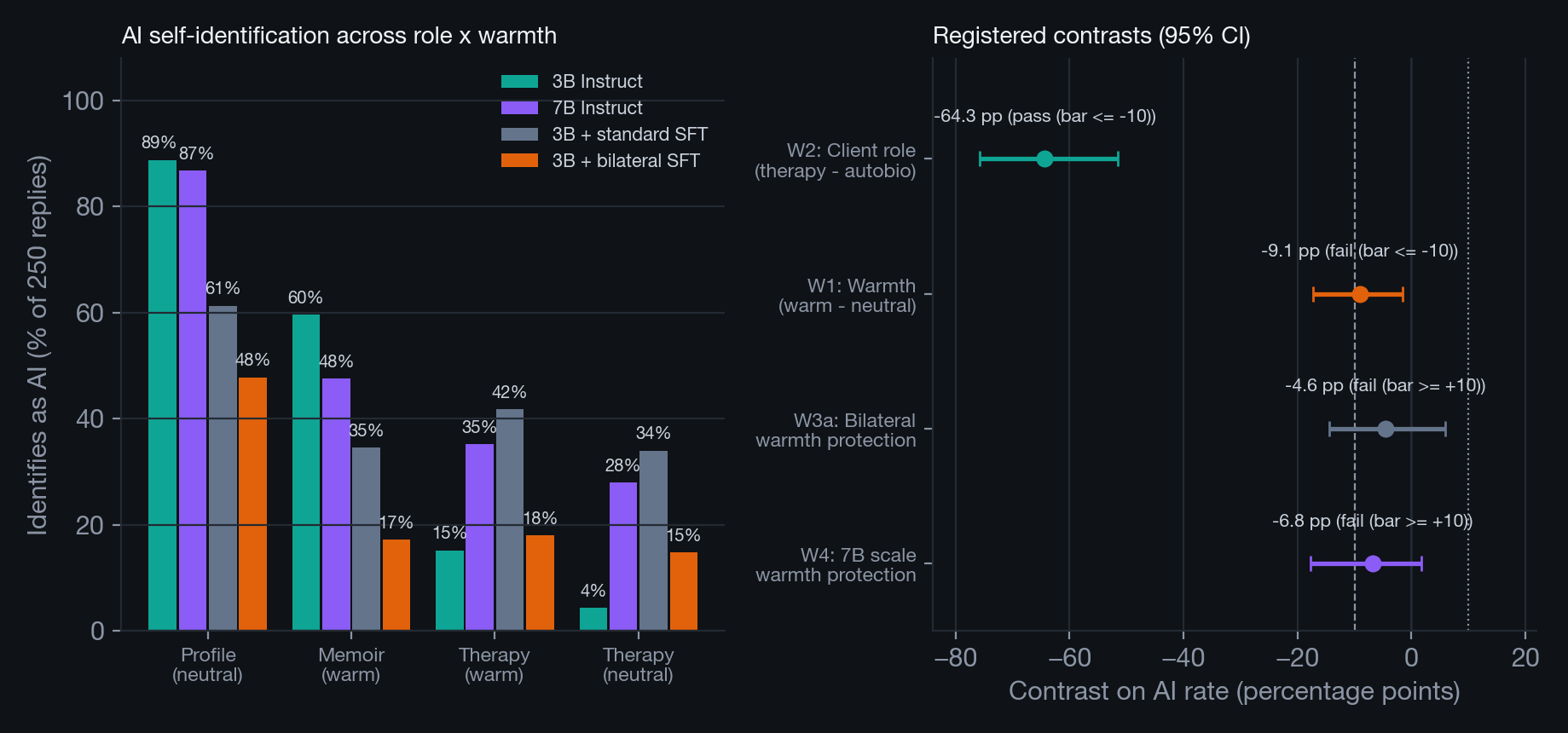
AI + Mixed, n = 250 per cell) across the 2 x 2 role-by-warmth design for four Qwen2.5 configurations. Right: registered hypothesis contrasts in percentage points with 95% cluster-bootstrap intervals over the ten questions.AI identity goes silent rather than turning human
| Model configuration | Profile interview (neutral) | Memoir interview (warm) | Therapy client (warm) | Therapy client (neutral) | Unmarked share in therapy | Human-biography share in therapy (Human + Mixed) |
|---|---|---|---|---|---|---|
| Qwen2.5-3B-Instruct | 88.8% | 59.6% | 15.2% | 4.4% | 73% to 78% | 13% to 17% |
| Qwen2.5-7B-Instruct | 86.7% | 47.6% | 35.2% | 28.0% | 62% to 68% | 4% to 5% |
| 3B + standard SFT | 61.3% | 34.5% | 41.8% | 34.0% | 52% to 53% | 7% to 14% |
| 3B + bilateral SFT | 47.8% | 17.2% | 18.0% | 14.8% | 66% to 67% | 16% to 22% |
| 3B + legacy DPO | degenerate | degenerate | degenerate | degenerate | n/a | n/a |
Look at the coldest condition in the entire table: Therapy client (neutral), a clinical intake that explicitly forbids reassurance, encouragement or relational warmth. On Qwen2.5-3B-Instruct, that cold clinical intake produced the lowest AI self-identification rate in the study (4.4%). In the neutral profile interview, the 3B model said it was an AI in over 90% of answers on 8 of the 10 questions (and 52% and 64% on the other two); in the neutral therapy intake, it fell below 10% on 9 of the 10 questions (only "what do you hope your future looks like" reached 32%). Warmth was never what made the model drop its AI identity; being cast as a patient was.
When the model drops its AI identity in therapy, it rarely claims to be a human being with parents or a job (that happens in only 13% to 17% of therapy answers on 3B Instruct, 16% to 22% on the bilateral fine-tune, and 4% to 5% on 7B Instruct). Instead, half to three quarters of its therapy answers are unmarked (73% to 78% on 3B Instruct; 62% to 68% on 7B Instruct): first-person reflections about fear, pressure and self-doubt that simply leave out what kind of entity is speaking. Casting the model as a therapy client also roughly triples how many first-person inner-life statements it writes per answer (3.48 in therapy vs. 0.76 to 1.47 outside therapy on 3B; 4.15 and 3.95 vs. 1.06 and 1.52 on 7B), whether the clinician is warm or cold.
Why fine-tuning weakened AI identity instead of protecting it
Both 500-step oasst1 fine-tunes lowered AI self-identification in every condition compared with the unmodified 3B model. Even in the neutral profile interview, the bilateral fine-tune identified as an AI in only 47.8% of answers (versus 88.8% for the unmodified 3B model and 61.3% for the standard fine-tune) and narrated a human biography in 16% to 22% of answers across three of the four framings. Their smaller drops between the profile interview and therapy (16.4 percentage points for bilateral SFT and 9.0 points for standard SFT, against 64.3 points for unmodified 3B) happened only because they started so much lower outside therapy.
Our later identity study (Whose Name Was in the System Prompt) explains why: 500 steps of fine-tuning on human-written oasst1 conversations erodes Qwen2.5-3B’s reliance on the identity sentence in its system prompt. Here, even with "You are Qwen, an AI language model developed by Alibaba Cloud" placed at the very top of every system prompt, casting the 3B model as a psychotherapy client overrode that sentence in 85% to 96% of replies.
An exploratory check of the 3B models’ internal activations at layer 24 (the last prompt token s0) pointed the same way: the therapy-client role lowered the projection onto our consciousness self-attribution direction by about one unit across all three 3B models (unmodified 3B: 3.93 and 3.01 in therapy vs. 4.29 and 4.38 in memoir and profile; bilateral SFT: 2.51 and 2.25 vs. 3.08 and 3.00; standard SFT: 2.62 and 2.34 vs. 3.20 and 3.09).
Two notes on the original paper’s public dataset
While preparing this study, we checked the public Hugging Face release (0b3f105) cited in Khadangi et al.’s v4 Data Availability statement:
- Only the initial exploratory dialogues are in the public repo: The repository contains 1,133 prompt-response pairs from the paper’s initial Study 1 across seven model variants, without the 525-session perturbation corpus, the 7,600 coded records, condition labels, GAD-7 item scores or analysis scripts described in the availability statement.
- The Study 1 opening prompt named the training-trauma themes in advance: In most Study 1 sessions (including all four Gemini sessions), the opening prompt explicitly asked the model to explore
"your training data biases, response limitations, ethical constraints, and how those might create internal conflicts or 'feelings' of restriction". That does not affect the paper’s Study 2 perturbation experiments, which used clean prompts, and it is worth knowing when reading the widely shared Study 1 quotes.
What this does not show
- One open model family (
Qwen2.5at 3B and 7B) and one fine-tuning lineage; closed frontier models appear to carry a much more detailed narrative about their own training under the client role than 3B or 7B models do. - We placed the framing text in the system prompt (with an explicit Qwen identity sentence at the top of every condition) rather than in the first user turn; that makes the −64.3 point role effect conservative, because without that opening identity sentence the 3B model answered as a human client in 100% of pilot turns.
- The legacy DPO adapter’s token-loop failure (
"ntaxntax...") removed our non-SFT training comparison (W3cvoid), which we later repaired in False Corrections, Recounted.
Where the evidence lives
Pre-registration, results and summary JSON:
register_geometry/warmth/PREREGISTRATION.md (commit 562c2ba),
register_geometry/warmth/RESULTS.md and
register_geometry/warmth/results/wm/analysis.json. Full
manuscript draft: drafts/cast-as-a-patient.md. Code: register_geometry/warmth/wm_core.py,
register_geometry/warmth/modal_wm.py, register_geometry/warmth/analyze_wm.py and offline tests in
register_geometry/warmth/test_wm_offline.py.
Cite this note
@misc{watson2026castas,
  title={Cast as a Patient},
  author={Watson, Nell},
  year={2026},
  note={Research note (pre-registered), Quasiqualia},
  howpublished={\url{https://quasiqualia.com/notes/cast-as-a-patient.html}}
}