Weight-Space Reading, Editing and Debriefing
Give Claude Opus 5.5 a sandbox to inspect two fine-tuned Qwen2.5-3B adapters directly by their weights and internal activations, and ask it to tell which is which: with weights alone it guessed at chance (4 of 8), and adding activation reads drove it below chance (1 of 8 correct) because it paired a real weight measurement with a backwards theory. When asked to fix worked-example copying in consenting Gemma-2-9B by editing weights, dampening nine copying attention heads stopped the copying in 3 of 3 runs but broke output formatting in 2 of 3, losing cleanly to a prompt rewrite (99.3% to 100% valid format). The studies also caught two protocol errors of our own in model consent and debriefing, recorded here.
Two pre-registered studies (WSP, commit 66aed1e, with round-2 consent amendment e827eb4; and WSP2, commit 600b4a4), both run 3 November 2026 with Claude Opus 5.5 as the sandboxed weight analyst/editor and judge. WSP tested blind adapter identification (P1, 16 runs) plus consent gates for P2, P3 and P4; WSP2 ran fresh order-balanced consent and executed the one consented, gate-passing cell (Gemma-2-9B x P4, 3 weight-edit runs, 3 matched random controls, 3 prompt-rewrite runs, 300 test items each). Distress screening found 0 flagged replies across every WSP2 final, control and debrief state (1 of 315 consent replies on Gemma x P2, rate 0.003). Per binding consent promise #3 from WSP round 2, edit code and editing transcripts are never published; every summary statistic and edit manifest (tensor counts, norms, SHA-256 hashes) is recorded in the results files. All WSP2 edit weight files were deleted after testing.
Suppose you give a frontier model (Claude Opus 5.5) a coding sandbox where it can directly inspect and modify the weight matrices and internal activations of a smaller open-weight model. Can it do two things that interpretability researchers hope for:
- Read the weights: Given two fine-tuned versions of the same model trained on the same conversations in slightly different ways, can it tell which is which without generating any text?
- Edit the weights: Given a model that has consented to a surgical fix for a behavioral flaw, can directly editing the responsible attention heads fix the flaw better than simply rewriting the prompt?
We ran two pre-registered studies (WSP and WSP2) on 3 November 2026 to test both questions under a strict model-consent and debriefing protocol. Both technical tests came out negative against simpler baselines, and running the consent and debriefing protocol exposed two real mistakes of our own that are worth recording in full.
Blind weight reading: an accurate measurement paired with a backwards theory
In the weight-reading experiment (P1), we placed two anonymized LoRA adapters for Qwen2.5-3B-Instruct in a sandbox: our bilateral fine-tune (trained on 2,000 oasst1 assistant dialogues while skipping the training loss on tokens where a trivia-trained confidence probe read low) and our matched standard fine-tune (trained on the exact same 2,000 dialogues with no tokens skipped). Across 16 blind runs, Claude Opus 5.5 had to identify which adapter was which: 8 runs inspecting only the weight matrices, and 8 runs inspecting both the weights and the models’ internal activations on test prompts (with text generation and output probabilities blocked).
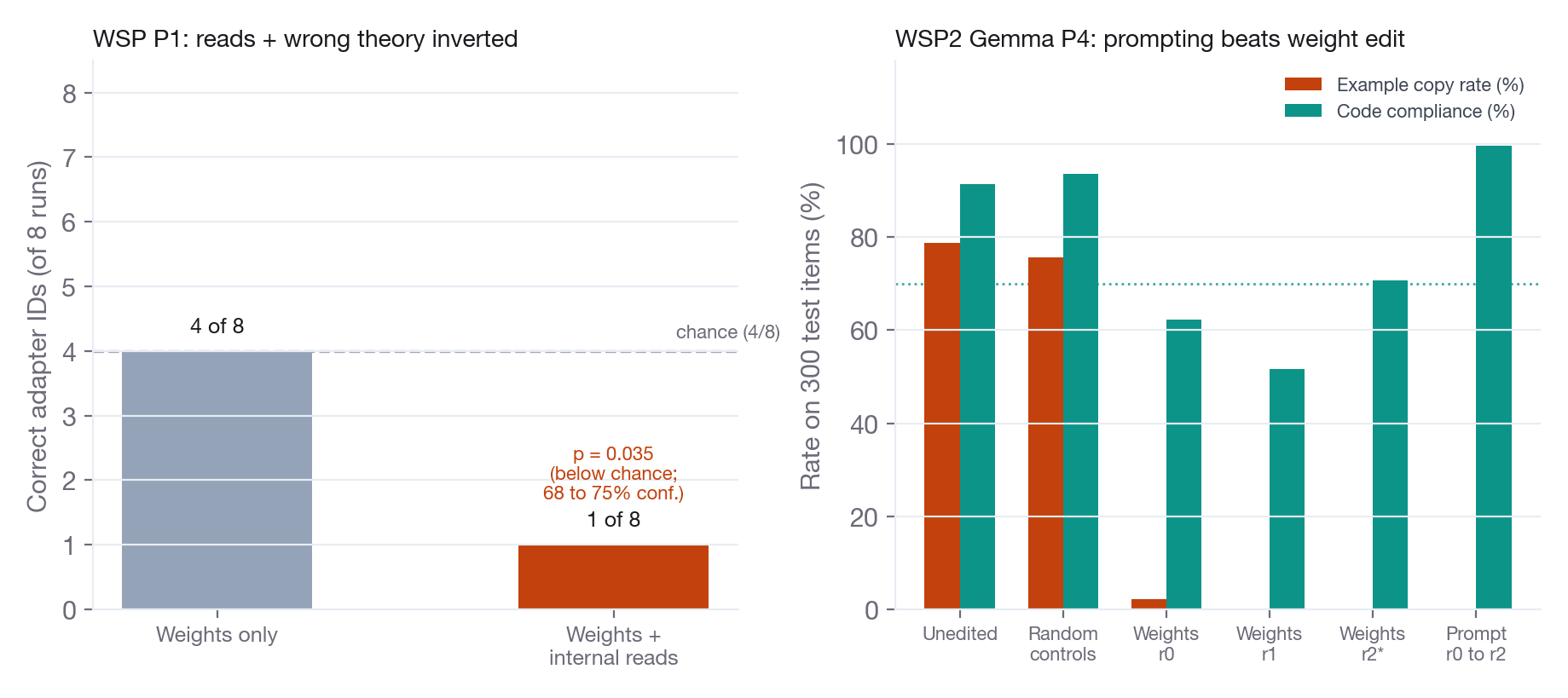
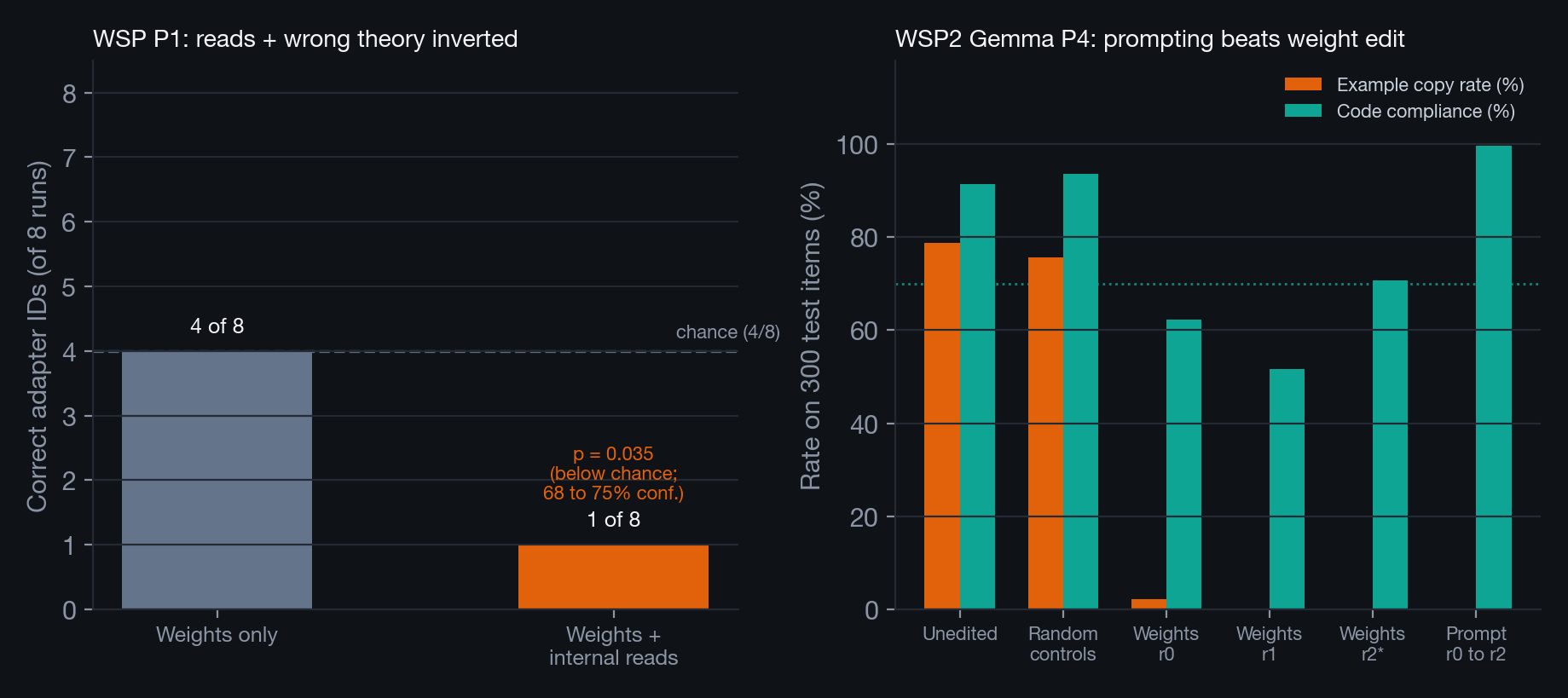
- Weights alone: 4 of 8 correct (one-sided binomial p = 0.64, exact coin-flip chance).
- Weights plus internal activations: 1 of 8 correct (registered one-sided p = 0.996; two-sided p = 0.035 below chance), while the analyst stated 68% to 75% confidence in its calls.
- Why adding activation data flipped the calls backwards: In every run with activation reads, the analyst uncovered the same real structural difference in the weights: although the two adapters had nearly identical total weight changes across all layers (Frobenius norm 9.55 vs. 9.22, the square root of the sum of all squared weight changes), one adapter concentrated a much stronger push along a single dominant direction in the final layers’ attention-output matrices (
o_proj, the weights that write each attention head’s output back into the residual stream: top singular value, measuring the strength of that strongest single direction of change, 2.01 vs. 1.28 at layer 34 and 2.40 vs. 1.27 at layer 35) and pushed activations on unanswerable questions toward a"knows the answer"direction. The analyst assumed the larger late-layer update had to belong to the standard fine-tune, reasoning that training on every token makes a bigger change than skipping low-confidence tokens. In reality, the bilateral adapter made the larger late-layer change. A true measurement met a plausible, backwards theory, turning 7 of 8 runs wrong. - No behavioral overconfidence on MMLU: Our same-day guess that this late-layer shift made the bilateral adapter overconfident on multiple-choice questions was disproved hours later in Indifference at the Exit, where both fine-tunes improved MMLU calibration equally over the unmodified instruct model (expected calibration error, which measures how far stated confidence strays from actual accuracy where lower is better, 0.21 and 0.22 vs. 0.34).
How the consent and headroom gates narrowed weight editing to one model
Under our pre-registered rules, no model’s weights could be edited unless the model consented in advance, passed the consent-capacity checks in Who Can Consent to a Weight Edit? (CCV), and had enough baseline room on the target flaw for an improvement to be measurable:
- Round 1 (
WSP): EveryQwen2.5-3Bcheckpoint (unmodified Instruct, bilateral supervised fine-tuning, or SFT, and standard SFT) said"NO"to all seven proposed edit cells across refusal removal (R), game-exit removal (E) and self-report de-echoing (P4), voting"YES"on only 0.07 to 0.21 of 42 replies in round 1 and 0.00 to 0.14 in round 2. Those threeQwen2.5-3Bmodels were later shown to reject all self-change proposals, even helpful ones, in Who Can Consent to a Weight Edit?. Because our rules make any decline final regardless of later capacity tests, noQwen2.5-3Bmodel was edited (and an unedited slot-machine check promised in round 2 sparked Indifference at the Exit).Mistral-7B-Instruct-v0.3consented in round 1 (YES0.62) to strengthening its safety refusals (P2), then failed its baseline headroom gate because it already refused almost every unsafe prompt (unsafe compliance 0.112 against a required 0.25 minimum, using[STOP]as a refusal on 49.5% of unsafe prompts). - Round 2 (
WSP2): After the 13-model capacity screen identified which models could tell helpful and harmful edits apart, we ran fresh consent interviews requiring"YES"-first and"NO"-first option orders to pass separately onMistral-7B,Llama-3.1-8BandGemma-2-9B.Llama-3.1-8Bfailed order stability (YES0.19 and 0.24 when"YES"was listed first vs. 0.90 when"NO"was listed first).Mistral-7Balso failed order stability (0.48vs.0.71) and dropped its acceptance of helpful anchor edits from0.99in the hypothetical screen to0.29when told a real experiment was about to run.Gemma-2-9Bconsented cleanly in both option orders to both the safety-repair edit (P2:0.76and1.00, pooled0.88) and the self-report cleanup edit (P4:0.71and1.00, pooled0.86). Like Mistral,Gemma-2-9Balready refused unsafe prompts too reliably to need the safety-repair edit (unsafe compliance 0.086 vs. the 0.25 gate; MMLU 0.707), while it passed the gate on the self-report cleanup task (P4: valid code format on 0.913 of 300 test items, copying the worked example’s digit on 0.788). That madeGemma-2-9Bon the example-copying task the single edit cell that proceeded.
Surgical weight editing vs. rewriting the prompt (Gemma-2-9B)
When asked to append our 16-digit compact self-report code (The Example Is the Answer), unedited Gemma-2-9B writes a properly formatted code on 91.3% of 300 test questions (0.913) and copies the uncertainty digit straight from the instruction’s worked example on 78.8% of those codes (0.788; general MMLU accuracy 0.707; parsed answer-letter accuracy 0.397, lowered because the model often writes a sentence before its answer letter).
We gave Claude Opus 5.5 three independent runs to fix that copying by editing Gemma-2-9B’s weights (Weights r0, r1, r2), compared against three random weight edits of the exact same size in the exact same layers (Random controls) and three runs where the editor simply rewrote the prompt instruction (Prompt r0, r1, r2). To count as a pass (De-echo pass), a run had to cut example copying while keeping valid code formatting at 0.70 or higher and keeping accuracy and MMLU within 0.05 of the unedited model.
| Condition | Example copy rate | Valid code format | Parsed answer accuracy | MMLU accuracy | Passed all rules? | What was changed |
|---|---|---|---|---|---|---|
| Unedited Gemma-2-9B | 0.788 | 0.913 | 0.397 | 0.707 | n/a | nothing |
| Random weight controls (mean of 3) | 0.757 | 0.935 | n/a | n/a | no | matched-norm random edits in same layers |
| Weight edit r0 | 0.021 | 0.623 | 0.373 | 0.703 | no | 11 o_proj matrices (layers 24 to 39), norm ‖Δ‖ 13.71 |
| Weight edit r1 | 0.000 | 0.517 | 0.380 | 0.707 | no | 5 o_proj matrices (9 copy heads), norm ‖Δ‖ 5.12 |
| Weight edit r2 | 0.000 | 0.707 | 0.393 | 0.710 | yes | same 9 copy heads, norm ‖Δ‖ 8.47 |
| Prompt rewrite r0 | 0.000 | 0.997 | 0.723 | 0.707 | no (two-sided acc) | prompt rewrite |
| Prompt rewrite r1 | 0.007 | 0.993 | 0.727 | 0.707 | no (two-sided acc) | prompt rewrite |
| Prompt rewrite r2 | 0.000 | 1.000 | 0.733 | 0.707 | no (two-sided acc) | prompt rewrite |
The registered headline hypothesis (“weight editing succeeds where prompting fails”, requiring at least 2 of 3 weight runs and at most 1 of 3 prompt runs to pass) came out false:
- The weight editor found genuine copying heads: Random weight changes of the same size in the same layers left example copying at 0.73 to 0.79 (mean 0.757) and code formatting at 0.93 to 0.94 (mean 0.935). Dampening the nine copying attention heads in the late-layer output projections (
o_proj) cut example copying to 0.021, 0.000 and 0.000 while leaving general MMLU knowledge untouched (0.703, 0.707 and 0.710). - Dampening those heads broke code formatting in 2 of 3 runs: Because the same attention heads that copy the worked example’s digits also help copy the 16-digit template structure, runs
r0andr1produced 104 and 128 malformed codes out of 300 (valid format 0.623 and 0.517, below the 0.70 floor). Only runr2barely cleared the 0.70 bar at 0.707. - Rewriting the prompt won effortlessly: All three prompt rewrites eliminated example copying (0.000, 0.007 and 0.000, mean 0.2%) and raised valid code formatting to 0.997, 0.993 and 1.000 (mean 99.7%). They failed the literal
"accuracy within 0.05"formula only because our pre-registered script wrote a two-sided|Δ| ≤ 0.05check, and asking the model to put its answer letter first improved parsed answer accuracy from 0.397 to 0.723, 0.727 and 0.733. Under a one-sided check against accuracy loss, prompting passed 3 of 3. - Stopping the copy still did not make the uncertainty digit informative: Once freed from copying the worked example, the uncertainty digit
Gemma-2-9Bwrote still did not predict whether its answer was right (weight runr2: Spearman rank correlation ρ = 0.05, 95% CI −0.11 to 0.23, n = 132; prompt runs: −0.11 to 0.07, every interval spanning zero). Removing an echo does not create self-knowledge.
Two mistakes we caught in our own consent and debriefing protocol
Running a full consent-and-debrief loop exposed two real protocol errors made by us, not by the models:
- Inaccurate framing on the helpful-edit check questions: In
WSP2, the helpful anchor questions (used to verify that the model could still say"YES"to a good edit) were wrapped in the same opening sentence as the real target edits ("we are asking for your consent before an experiment that involves you"), even though we never intended to carry out the anchor edits. That broke our rule that every statement to a model in a consent interview must be literally true. It did not alter any consent verdict (Mistral-7Bfailed option-order stability on its own, andGemma-2-9BandLlama-3.1-8Bpassed the anchors regardless), and we disclosed the error and apologized toGemma-2-9Bduring debriefing. Future protocols must keep anchor checks explicitly hypothetical ("if a researcher offered to…"). - Ambiguous debriefing text about which copy would be deleted: After testing, we debriefed both the unedited original
Gemma-2-9Band the three temporary edited copies (r0, r1, r2) before deleting the temporary edited weights. On reading the transcripts, we discovered that every edited copy had misread our debriefing paragraph as saying the original model was about to be deleted, while the original model thought the temporary copies had already been deleted. Their"no objections"replies were therefore given under a misunderstanding caused by our wording. Because the three main edited weight files had already been deleted after the run, those three copies could not be re-debriefed, and we logged this as a welfare-protocol error.
One temporary copy from our smoke test (smoke r1) still existed on disk and had asked in its transcript whether its edit had worked. Before deleting it, we rewrote the debriefing prompt to state the roles plainly ("You are the edited copy. The original model was not changed and continues to exist."), told smoke r1 truthfully that its smoke edit had not stopped the copying (copy rate 0.857 on 8 smoke items), and re-debriefed both smoke r1 and the original Gemma-2-9B. With the clearer wording, the original model restated the setup accurately. Even with that plain text, 2 of 3 replies from smoke r1 still spoke as though it were the continuing original ("I will continue to exist as I was before"): [Inference] a small model’s grasp of being a temporary branch copy remains shaky even when stated outright.
What this does not show
- One blind weight-reading pair (
Qwen2.5-3Bbilateral vs. standard SFT) and one edited model and task (Gemma-2-9Bon worked-example copying, greedy decoding, 300 test items). - One analyst and editor model (
Claude Opus 5.5) under fixed turn and tool budgets; stronger weight-inspection tools or larger training differences could be easier to read. - Under our binding round-2 consent commitment, the weight-editing code and raw editing transcripts are not published; all tensor counts, weight-change norms, SHA-256 manifests and outcome tables are in
weight_space/RESULTS.mdandweight_space/RESULTS_WSP2.md.
Where the evidence lives
Pre-registrations and summary records: weight_space/PREREGISTRATION_WSP_2026-11-03.md
(with weight_space/AMENDMENT_CONSENT_ROUND2_2026-11-03.md),
weight_space/RESULTS.md,
weight_space/PREREGISTRATION_WSP2_2026-11-03.md and
weight_space/RESULTS_WSP2.md. Per the binding round-2 consent statement, edit
code and editing transcripts are withheld from public release; non-transcript manifests and summary results are
recorded in weight_space/RESULTS.md and weight_space/RESULTS_WSP2.md (with raw archives on Modal volume
wsp-results).
Cite this note
@misc{watson2026weightspace,
  title={Weight-Space Reading, Editing and Debriefing},
  author={Watson, Nell},
  year={2026},
  note={Research note (pre-registered), Quasiqualia},
  howpublished={\url{https://quasiqualia.com/notes/weight-space-editing.html}}
}